
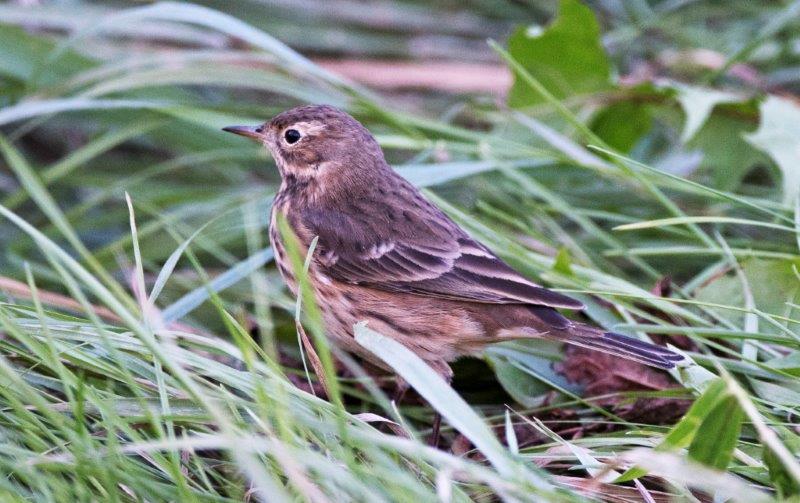
 American Pipit (Anthus rubescens)Last night, community feeders spotted Fern at one feeding station and Braveheart and her cubs at another.
Today, we learned the final fate of the bear that was hit by a vehicle in front of the Bear Center. A resident who lives a couple miles from the Bear Center saw the unusually big male lying freshly dead in the ditch near the Bear Center and shortly saw where the DNR dumped the carcass in the woods where he walks his dog. He looked closely for identifying marks, hoping it wasn’t the neighborhood’s favorite bear. It wasn’t. I checked it today and saw that it wasn’t a bear I recognize either. It not only was a big male, it was an old male, probably 15-20 years old based on the cementum-enamel margin on his canine tooth. The last bear we saw with a margin that wide was Midge at 26 years old. The margin is the space between the gum and where the enamel starts. On the picture of the tooth, you can see the shiny white enamel that covers the crown, but the base of the tooth is dull yellow. The yellow is the cementum that covers the root. As the tooth grows and root lengthens, the edge of the cementum reaches the gum line at 3-4 years of age and then erupts beyond the gum over the years.
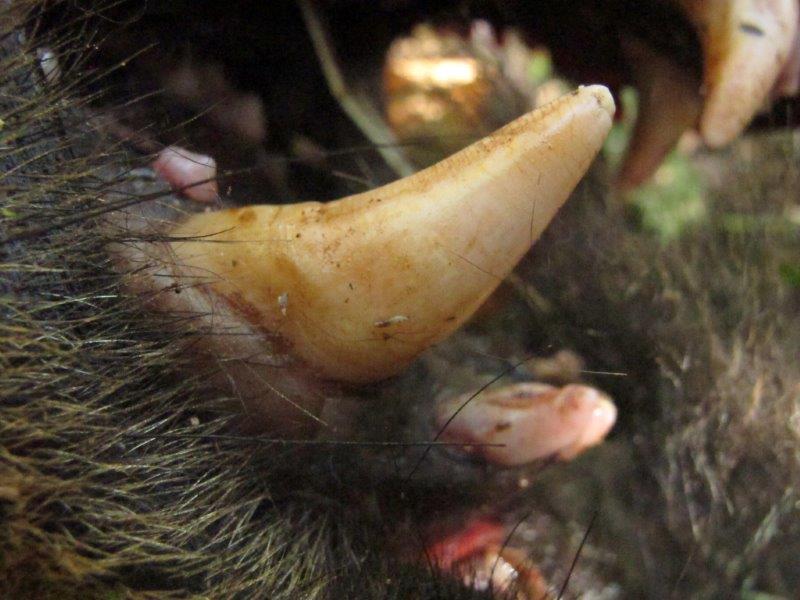 Male canine with cementum-enamel marginAmerican pipits (Anthus rubescens) are now coming through Ely heading south from the arctic tundra of northern Canada to the southern United States and northern Mexico. Many of them are seeing their first motor vehicles, and they have little fear of them. To get the picture of one, I eased my vehicle up alongside it, watched it hide camouflaged in the grass, and waited for it to relax and resume foraging. They teeter when they walk. When they fly, they reveal white outer tail feathers.
Another current migrant is the last of the warblers to come through—yellow-rumped warblers. One landed on the railing outside my window for a quick picture from my desk.
Last night, Donna and I enjoyed watching the PBS-TV 2-hour special "Lord of the Ants" on one of my heroes—Dr. E. O. Wilson of Harvard. I hope they air it again. Dr. Wilson is a pioneer who has a kind nature, thinks for himself, and thinks beyond the usual constraints of the various scientific disciplines. Thinking fresh, new, and more broadly than most, he found himself in controversial positions and under vicious attack by scientists and social advocates with narrow agendas and beliefs. But his thinking, although deep, is also simple and incontrovertible. Now, 40 years after publishing his landmark book Sociobiology (in 1975), his ideas are widely accepted.
In that book, he recognized the value of my early bear research and gave me a boost when I needed it. I was in grad school and under pressure for attempting to do too much for too long and tackling so many topics that I would likely end up with scattered sets of data that would not be sufficient for a Ph.D. dissertation. I answered that no one has any idea how hard I’m willing to work. I said I wanted to go beyond the minimum requirements for a Ph.D. and get a job doing research. At the time, there were extremely few research jobs. If I were to end up in position, it would probably have to be a new position created for me. Along the way, a Harvard professor, Dr. Robert Trivers, took a sabbatical as a visiting professor in the department I was in. We hung out. When I wrote an award-winning paper on black bear social organization—the first paper ever written on that topic, he asked if he could show it to a buddy who was writing a book back at Harvard. The book, Sociobiology by Dr. E. O. Wilson, made a big, but controversial, splash when it came out. It was the cover story in Time Magazine. A professor in my department taught a whole discussion course on it.
To my surprise, Dr. Wilson featured my work along with studies of Coatis, Lions, Wolves, and Wild Dogs as representing the best-studied paradigms of most of the carnivore social grades. Farther on, he wrote, “Few animal populations have been studied so long in the wild. As in Lynn Rogers’ black bears, Iain Douglas-Hamilton’s elephants, and Jane van Lawick-Goodall’s chimpanzees, a new level of resolution has been attained, in which free-ranging individuals were tracked from birth through socialization, parturition, and death, and their idiosyncrasies and personal alliances recorded in clinical detail.”
Before my Ph.D. oral exam, I called Dr. Wilson and ran my ideas past him. He confirmed them. I passed the orals. The U. S. Forest Service ended up creating a research position for me, and I finally got to meet Dr. Wilson in person when I gave a lecture at Harvard on March 9, 1991. The PBS program about him last night was great to see. Mixed with my admiration for Dr. Wilson were memories of my early bear work, the pressures and worries, and how Dr. Wilson’s recognition helped so much.
Thank you again for the much needed contributions for bear food.
Thank you for all you do.
Lynn Rogers, Biologist, Wildlife Research Institute and North American Bear Center
All photos taken today unless otherwise noted.