
Mixed age litters
November 1, 2010 – 8:09 PM CDT
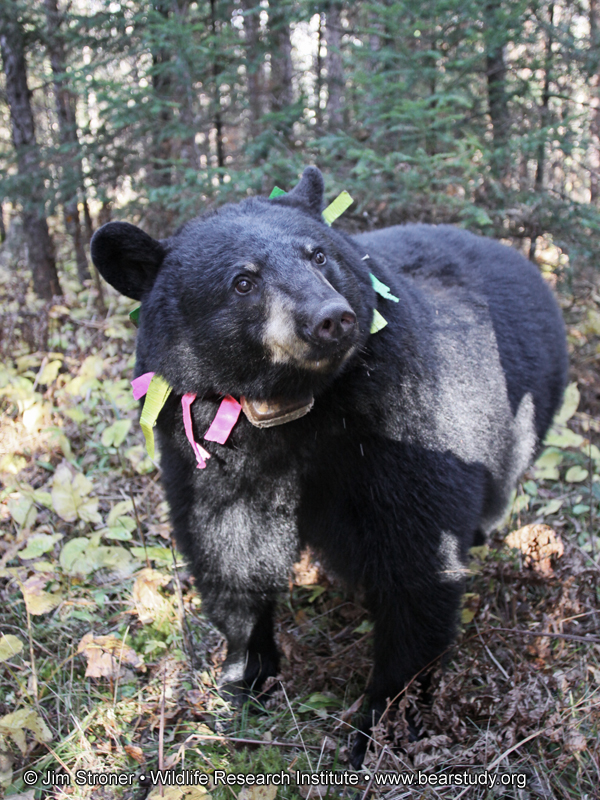 No visits to bear dens today, so we dug out some pictures of Jo taken on Oct 3 that are too funny not to share. Enjoy!
We are looking forward to learning how things go in the den with a mixed-age litter. Our very own Jason Sawyer videotaped a mixed age litter in northeastern Minnesota a couple years ago. The video is a preview of what we might see next summer http://www.youtube.com/watch?v=rvEr96tt_Ww. As usual, there is just one older cub, and multiple younger ones.
It is undoubtedly a situation similar to what happened with Lily and Hope. The older cub probably couldn’t nurse enough to prevent the mother from coming into estrus and mating. Somehow, the lone cub survived through the estrus period in late spring and early summer and went on to den with the mother who gave birth to a new litter.
The lone yearling in this litter looks small, so it may have had a hard time surviving through the estrus period—probably on its own. We saw what a hard time Hope had on her own.
This video shows that the presence of an older cub (yearling) in the den does not necessarily mean the new litter will die. We wonder, though, how many other litters might have died due to interactions with an older cub. We are hoping that Lily will give birth to a new litter and that all will emerge healthy in April. So many questions about how they all will relate, who will share the milk, etc. We have much to learn.
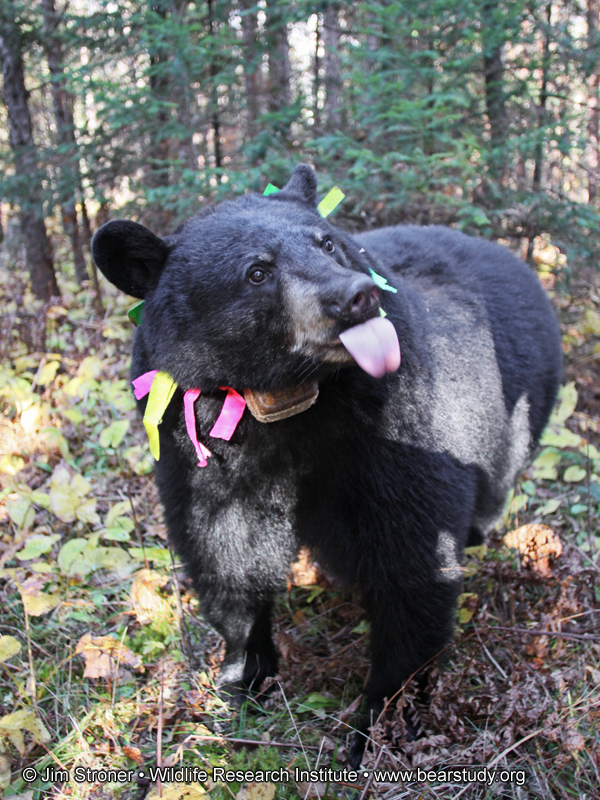 On another topic, this is the week the MN DNR will be deciding whether to protect radio-collared bears. The discussion we’ve heard is mainly about how that might inconvenience hunters by requiring them to look for ribbons and collars. However, in looking at the DNR’s mission statement http://www.dnr.state.mn.us/aboutdnr/mission.html, we think the discussion should be broader than that. We are reminded of a quote on page 63 in the latest issue of The Wildlife Professional (fall 2010), a magazine put out by The Wildlife Society. In an article about the need for changes in hunting regulations, Thomas Decker, Chief of Operations for the Vermont Fish and Wildlife Department, is quoted saying,
“Some people will say that the only people in our society who should debate these things are the hunters themselves. But the resources are managed in the public trust. They’re owned by no one and managed for the benefit of everyone, including people who don’t hunt.”
The peer-reviewed article goes on to say that “All people who value wildlife should therefore add their voices to the conversation.” That is exactly what you are doing in asking for protection of about a dozen radio-collared bears in this study and a couple dozen in the DNR’s study.
These research bears are immensely valuable to science, education, and regional economics. They have a value to the broader society that is beyond hunting. No longer should it be left up to individual hunters to decide whether they care more about filling their tags than about research, education, and regional economics.
The ribbons we place on the collars are very visible and durable. We don’t know why the decision to protect these few radio-collared bears is so difficult. It is not about hunting versus anti-hunting. It is about sparing these few bears for their other values.
The letters we have seen from you are excellent. Words we heard about you from merchants at the North American Bear Center yesterday were appreciative. They are noting what you are doing to benefit Ely through your voting and through your visits and expenditures in the Ely area. They know this is a result of the radio-collared research bears.
Thank you for all you do.
Lynn Rogers and Sue Mansfield, Biologists, Wildlife Research Institute and North American Bear Center