
Hope is becoming a bear
June 7, 2010 – 9:53 PM CDT
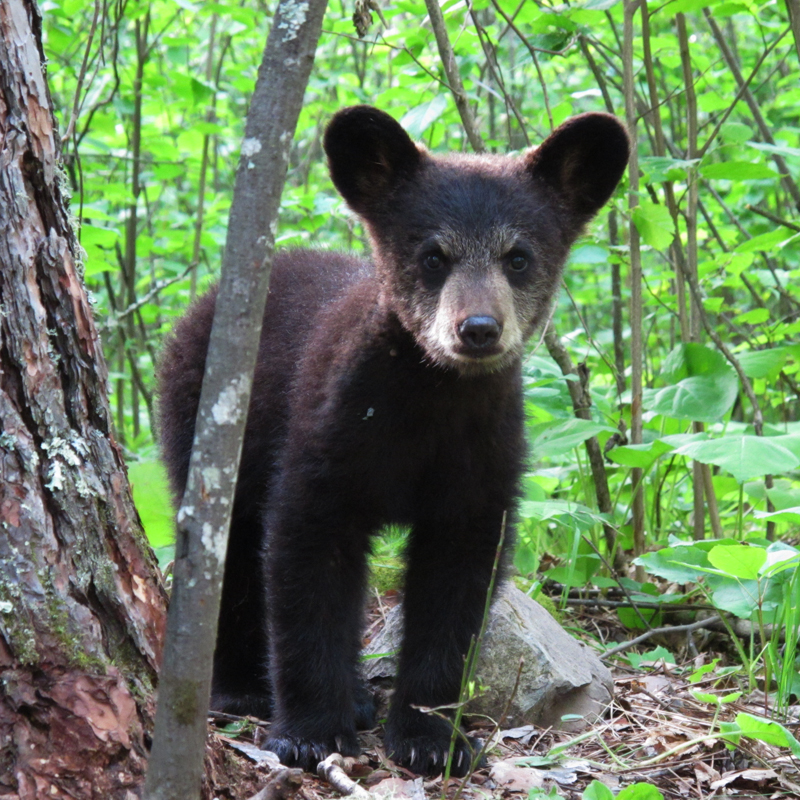
Hope is doing way more than we would have thought for her age. We went to her tree and feeding site this morning. The food had disappeared overnight, but she was nowhere to be seen. We replaced the food, which is now all being weighed because we thought it was her only food right now and we wanted to see how much she ate in a day. We knew the trail cams would show if she got all the food.
We went back out at 1:15 PM. All the food was again gone. The trail cam showed she was the one who got it all. But where was she? Then we saw droppings. One had bits of nuts and mealworm skins—both foods we gave her. The other scat was vegetation. She had been a busy little cub off feeding on her own.
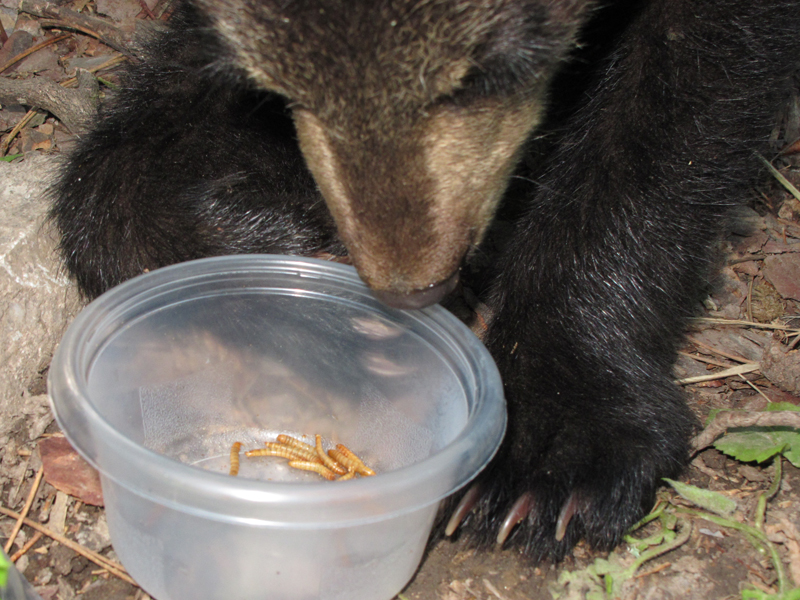 Sue stayed—hoping to begin building trust. Hours passed. Finally, at 6:45 PM, Hope came running—at least until she saw Sue. She stopped, veered out around, and went for the food. Every move Sue made meant a leap to the red pine for Hope. Sue slowly edged in and showed her a bottle with formula. Hope licked the nipple but that was all. Sue dumped it into the plastic container. Hope ate all the formula – as well as all the blueberries, pecans, and mealworms.
We assumed that she would then be so full she would climb a tree and take a nap. Wrong. She set about foraging. A short way off, she clawed open a log and licked up something Sue couldn’t see—probably a grub or some ant pupae.
Hope is getting stronger each day and is acting like a very independent, busy bear. All faster than we expected. This is all valuable information for people wondering what to do with orphaned cubs. Do all have to be taken to rehabilitation centers where their learning is limited to their pen? Or might some be better off in a temporary pen in the woods where they can learn where the formula is and then have the pen dismantled so they can roam and return? Just a thought, but it certainly would let the cubs learn a lot more than they could in a pen. There are stories of pen-reared cubs that didn’t know enough to climb trees to escape when they finally were released at a year and a half of age. We have yet to see how this all turns out, but we’re thinking that a little supplemental food to help a cub to independence in the wild is a win-win compromise at this point. It reminds us of raising fawns in the old days. We put up a pen and fed them with bottles. As soon as they learned about the bottles, we took down the pen and let them free. They came when we clanked the bottles together. They ate mostly wild food and eventually weaned themselves from the bottles.
Lily was busy traveling and foraging about 3 miles southwest of Hope and Grandma June passed by about three quarters of a mile to the west. At this moment, June is about to hit the 8-hours-old scent trail of Lily. The computer will tell us if she keeps going or turns and follows Lily. On this dry day, the scent trail should be good for about 12 hours. Lily and June were foraging like Hope was, but on a grander scale probably. We’re moving toward getting a tiny radio-collar on Hope so we can learn more about her landscape use at her tender age.
It also would be nice if she would step on a bathroom scale out in the woods one of these days. She had a great start getting all the milk. Then she had a setback as we know. Now she is getting a lot of formula, grapes, blueberries, mealworms, and nuts in addition to wild food. It’s hard to hold that bear down. Her weight is probably comparable to cubs with their mothers at this point.
With all your creativity out there, do any names for books pop into mind? I’ve thought for years, and the best I came up with was “My view of Black Bears and how it’s changed.” At first, I was going to write “Walking with bears” and then Terry Debruyn used that title for his great book. Then I thought of “Brother Bear” and a movie came out with that name. Then I thought of another title, and someone used that one. This time I’m going to write it before someone else can grab it—whatever the title ends up being.
Thank you for your contributions!
—Lynn Rogers and Sue Mansfield, Biologists, North American Bear Center