
Trying to Understand Lily, Looking for Hope
May 22, 2010 – 8:07 PM CDT
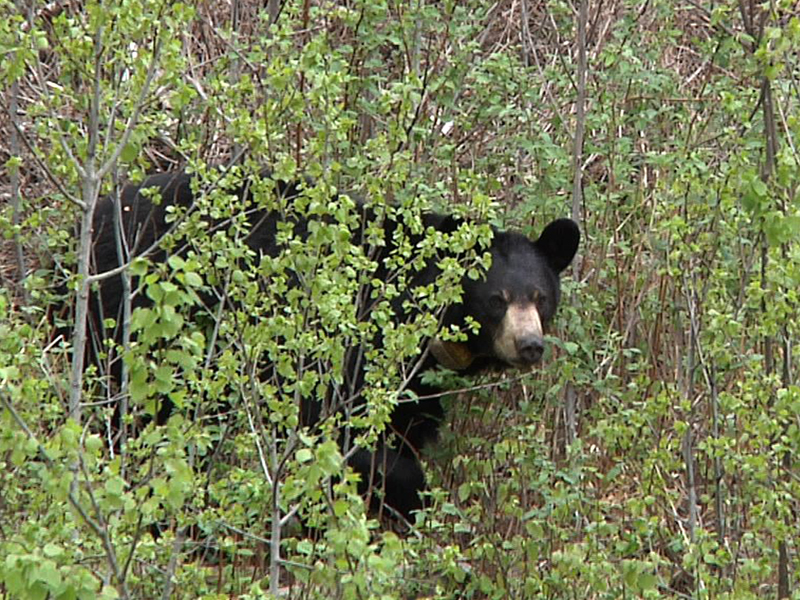 We spent the night and day trying to understand Lily and looking for Hope. At first, we watched the computer screen in disbelief as Lily moved a couple miles away. What was in her mind? She had come down from the big red pine where Hope was sleeping in the uppermost branches. She carefully sniffed deep bear tracks one after another. What information did she get from them? She mostly ignored the observer, as usual. Then, she calmly walked away as we have seen many times before. With Hope asleep, Lily often forages in the area, alert for any cry from the waking cub, which would bring her immediate return. The observer left but was mildly surprised by how faint the telemetry signal had become. Back at the Research Center, the computer showed she had eventually put her travel in high gear and was nearly 2 miles away. We watched the screen for her next move. She turned south instead of coming back east. About 11:30 PM, Lily settled down a couple miles from the red pine. We wondered if Hope had miraculously awakened and tracked down her mother. A check around midnight showed that Hope was no longer in the tree, but rustling nearby suggested she was still in the vicinity.
About 6 AM, Lily stirred. Surely she would quickly return now with her breasts full of milk. It had been over 12 hours since she had nursed Hope. She turned south and spent the day traveling and foraging up to 4 miles away from the red pine where she had left Hope. We had many questions. Had she become too hungry after spending day after day in areas that seemed too small to provide her needs—especially her extra needs with the drain of lactation? That didn’t seem to be the answer because she was about a half mile from a feeding station when she left the red pine. She could have easily gone there, but she didn’t. She hasn’t visited a house, bird feeder, garbage can, or feeding station all spring.
Could it be that little Hope, a single cub, wasn’t drinking enough to prevent estrus? Was she coming into heat without our noticing? Were the tracks she smelled from a male? Had she followed his scent? There are a number of records of mothers with only one cub breeding and spending the next year with a mixed age litter of one yearling and several cubs of the year. It was worth checking out. We saw on the computer that she was approaching a forest road where she would be accessible. We intercepted her, gave her a handful of nuts, and checked her out. She showed little or no swelling of the genitalia, her breasts were swollen with milk which was easily expressed, and her heart rate was a calm 75 per minute. She continued her travels.
At 4:47 PM, she stopped and rested for a couple hours. When she awoke around 6:50 PM, her initial movement was south, away from the red pine. She could make it back the three and a quarter miles to the red pine in a couple hours if she chose.
Another question is how common it is for a mother to be gone from her cub or cubs over 24 hours. This is the first year we have extensively used GPS technology to provide this level of detail about bear movements. Our old technology would not have revealed this. GPS alone, without the ability to observe the bears, would not have revealed this. Is our worry purely a result of learning new aspects of mother/cub relations? Have we witnessed the reason why people sometimes pick up cubs they think are abandoned when they really were not? Or has Hope really been abandoned?
We spent a good part of the day listening for Hope’s cries along the route Lily took. We checked places Hope had been in case she figured out how to return the two miles to where she had spent her life so far. Not a sound.
We check the computer and cell phone for the latest in Lily’s movements, looking for her to turn north and hurry back to the red pine or vicinity.
We are at our wits end. All we can do as biologists is observe and report. We think of things in human terms and try to see things from the bears’ points of view based on our decades of experience. But what makes human sense might not make bear sense. We can only watch and wait and hope for an end we can understand.
We will post a video at http://www.bear.org/website/lily-a-hope/den-cam-video-clips.html of our visit with Lily today.
Thank you for your continued support of our research and educational efforts.
—Lynn Rogers and Sue Mansfield, Biologists, North American Bear Center