
How do drought and fire affect berries, forests, and bears? We saw the short term effects this summer as the drought dried up the berries and the fires burned over a hundred square miles of forest, forcing bears to travel far and wide in their search for food. Long-term effects, however, can be beneficial to bears and other wildlife as fires reduce ground litter, undergrowth, and canopy, making it easier for berry producing plants and shrubs to take root and become productive.
The many sightings of bears this year are much like we’d seen when berry crops failed in 1985, a year when malnourished females lost most of their pregnancies, mothers produced so little milk that 88% of their cubs died within 18 months, and bears were being shot by the hundreds as they sought garbage or bird seed in residential areas.
However, even in 1985, bears survived and reproduced as usual in the 3 small problem-free areas listed here that had food available:
- Eagles Nest, a community that had peacefully coexisted with its bears for 29 years kept them out of trouble by welcoming them with diversionary food had enabled such coexistence and longevity that the bears included the second oldest black bear on record.
- Also problem-free in 1985 was the area within 10 miles of the huge Grand Marais garbage dump where residents had learned to accept bears.
- The third problem-free area was the U. S. Forest Service’s Kawishiwi River Campground and the adjacent residential area where I was in the second year of an 8-year experiment in which diversionary food a half mile away had quickly and successfully drawn the bears away from the campground and residential area for the duration of the experiment. To learn more, control-click the title of this scientific publication (Rogers, L. L. 2011. Does diversionary feeding create nuisance bears and jeopardize public safety? Human-Wildlife Interactions. 5(2): 287-295.).
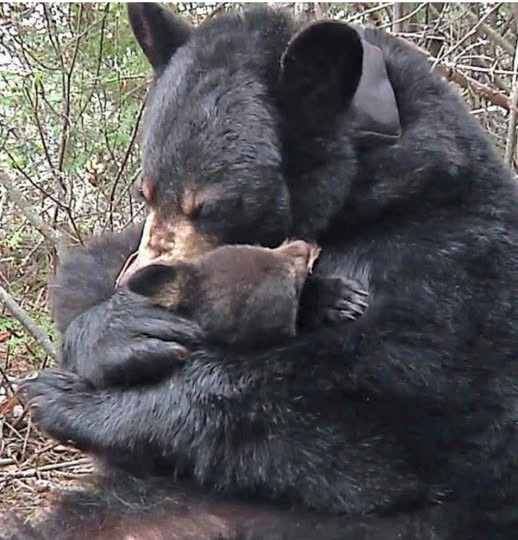
Now in 2026 when bears are again facing severe hunger and mortality, eight long-time bear advocates in the Ely/Eagles Nest area are using our findings to help 15 females maintain their pregnancies, to help 23 mothers make milk for 62 cubs, and to keep bears of all ages and both sexes out of trouble—all with amazing success. Despite the strain on our budget, the results are more than worthwhile. During the courses this year, we and the participants were deeply touched as we saw the many ways mothers and cubs show their love for each other—feelings that reminded me of this picture of Lily and Hope celebrating their reunion of May 20, 2010.
|
We need a cook for next year’s July and August bear courses Our wonderful cook of the past four years will be unable to come next year. I can only imagine how much she will miss the bears and the participants we look forward to seeing each year. If anyone is interested in filling in for the eight courses each Monday to Thursday in July and August, please give me a call at 218-235-8592(cell) or at 218-365-4480(w). |
Thank you for all you do,
Lynn Rogers, Biologist, Wildlife Research Institute and North American Bear Center