
Out the window, a doe and fawn standing by a block of date mash suddenly went on alert. What was coming?  Doe and fawnThen they (especially the fawn) crouched with front knees bent ready to spring and run. Suddenly they split apart and ran (picture too blurry in the waning light) while the buck with the broken antler came into view and pursued one of them for maybe 30 feet. This is the buck that I mentioned back in November as going up to a young doe and using his antler on her chest. The deer today knew this little buck and were afraid. I think he is notorious for using his antler to horn in on food or whatever. I have never seen such alertness by deer toward another deer approaching.
We have 4 male cubs and 4 female cubs to name yet in honor of people who helped my research over the fifty years since June 24, 1967. One name we have to include is Dr. Ulysses S. Seal. Ulie was a senior research scientist with the Veteran’s Administration Hospital in St. Paul, Minnesota, and chairman of the Conservation Breeding Specialists Group that is part of the Species Survival Commission of the International Union for Conservation of Nature (IUCN). He was a world leader in conservation. He was one of the pioneers in tranquilizing animals for research. Ulie oversaw the bear blood sampling and analysis I did from 1969 to 1991. We co-authored two papers.
One of Star’s male cubs is Ulie.
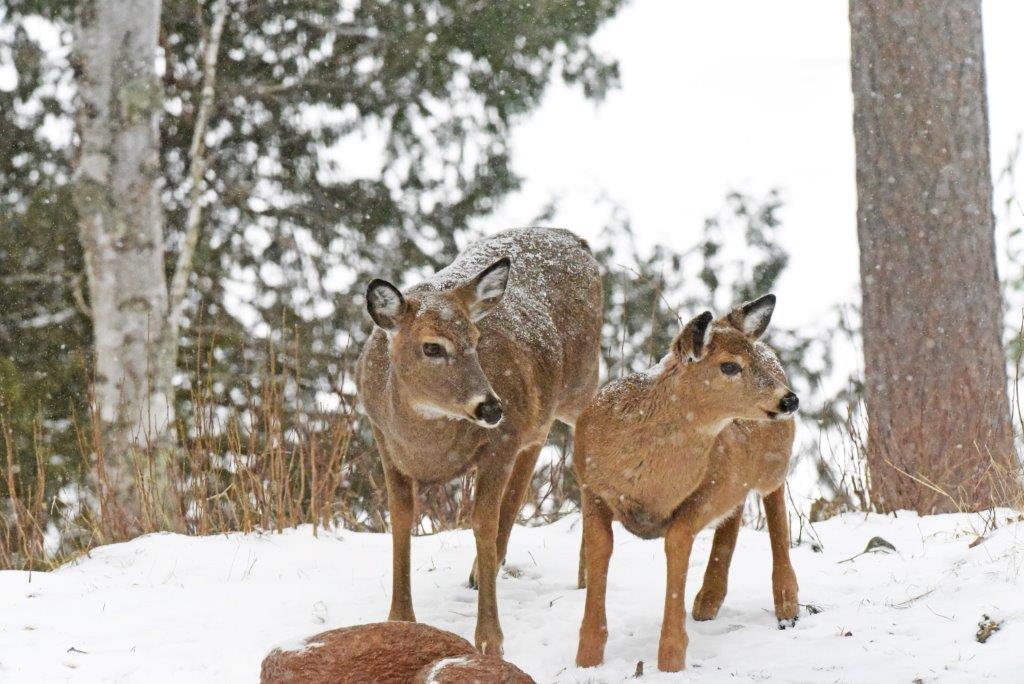 Doe and FawnDuring the white pine controversy, many people stepped up and deserve cubs named after them. Part of my study with the U. S. Forest Service was obtaining ecological bear data that could help ecosystem management. The bears we were radio-tracking and walking with showed us the value of big, scattered white pines. We hadn’t thought of them as that important because they have no food value to bears. But the bears showed us another value. Mothers with cubs passed up thousands of other big trees to make over 90 percent of their beds at the bases of these refuge trees that small cubs can climb most safely. I told the Superior National Forest Chief Biologist Ed Lindquist about that, and he supplied me with data on their importance to bald eagles, ospreys, and other wildlife and we co-authored a paper on it (Rogers, L. L., and Edward L. Lindquist. 1992. Supercanopy white pine and wildlife. Pages 39-43 in Robert A. Stine and Melvin J. Baughman (eds.) White Pine Symposium Proceedings NR-BU-6044.)
One of Ursula’s cubs of 2015 is named Ed for Dr. Edward O. Wilson. That cub now also represents Ed Lindquist.
Our pointing out the values of white pines to wildlife highlighted a problem. Nearly all of Minnesota’s white pines had been harvested over the previous century and only 2% had grown back. The scattered remaining mature white pines were the few that had been spared during that century; these were down to their last 0.1%. Further, white pines were regenerating especially poorly in northeastern Minnesota due to multiple human-caused problems. However, the scattered mature white pines were doing well. They had escaped the human-caused problems of regeneration. They were healthy and had centuries of life left in them, but were being cut. In fact, the new forest plan for Minnesota’s two national forests prescribed harvesting 86% of the remaining white pines in those national forest and replacing them with red pine and white spruce that give a bigger bang for the buck. The plan was contrary to ecosystem management, which I was studying and was supposed to make recommendations about.
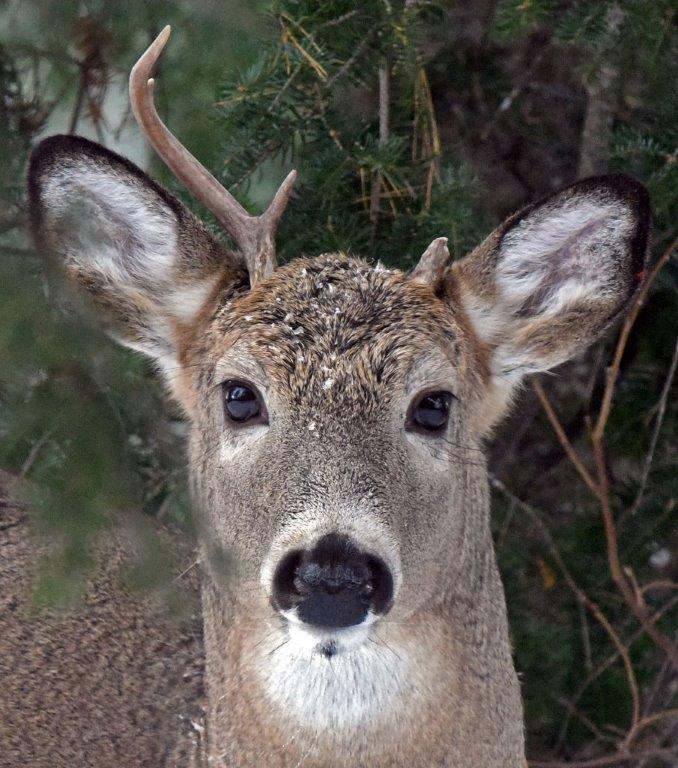 Deer with the broken antlerI recommended that the forestry agencies reverse direction. I recommended that public forestry agencies manage the public’s white pines sustainably and conduct research to improve regeneration. Both the USFS and the Minnesota DNR eventually adopted these recommendations, and Governor Arne Carlson provided 1.2 million dollars for the regeneration research. However, that didn’t happen without a struggle. Many people stood with me in sustainably managing the remaining white pines. Two of those people were Ray Fenner and Judy Bellairs of the Sierra Club. Another was Representative Willard Munger who joined me on a field trip and in February 1996 introduced a legislative bill to preserve the white pines. Writer Dean Rebuffoni of the Minneapolis Star Tribune backed that up with a full-page article about my work for the white pine on February 6, 1996 entitled ‘Keeper of the Pines.’ He included my graphs and such to make a difference with his article. The same newspaper did a big editorial on February 8, 1996 entitled ‘Our Perspective, White Pine, Stop the Cutting, Save the Remains.’ The effort was a success. Today, both the DNR and the USFS leave most white pines standing, including those in areas where all other trees are cut. On April 15, 1996, the Minnesota Wilderness and Parks Coalition named Rogers “Minnesota’s Environmental Hero” for “crusading to preserve and regenerate Minnesota’s depleted white pine forests.” Dean Rebuffoni announced it in the Minneapolis Star Tribune on April 16, 1996.
Ellie’s gray female cub is Judy. Shannon’s three males are Ray, Willard, and Dean.
Along the way, I needed legal funds. Co-worker Carolyn Quick and two other women formed a legal defense fund that was a big help. The main support came from 91 of my co-workers. A Minnesota artist did a big painting of me (tiny in the picture at my request) and the bears (big in the foreground) to help with the fundraising. We’ll name a cub for him in 2018.
Donna’s female cub is Carolyn.
A side story is that my friends Hugh Morton and CBS Journalist Charles Kuralt were at a party in Washington, D. C., talking with Bjorn Dahl, Chief Congressional Liason Officer for the U. S. Forest Service. Charles thought he’d drop a bomb. He said, “I’m from CBS and should let you know that “60 Minutes” is very interested in what the U. S. Forest Service is trying to do to Lynn Rogers. Dahl immediately responded, “The Forest Service is backing off on that.” And well they should. The two top officials (Chief and Associate Chief) perpetrating the problem were shortly targeted for a congressional probe by the Clinton Administration and were relieved of duty later that year. Charles was later good to buy the local Ely, Minnesota, WELY radio station and give me a half-hour weekly program on it called “The Bear Facts.” I hope next year we can name a cub Charles.
Many other names deserve mention.
Thank you for all you do.
Lynn Rogers, Biologist, Wildlife Research Institute and North American Bear Center