
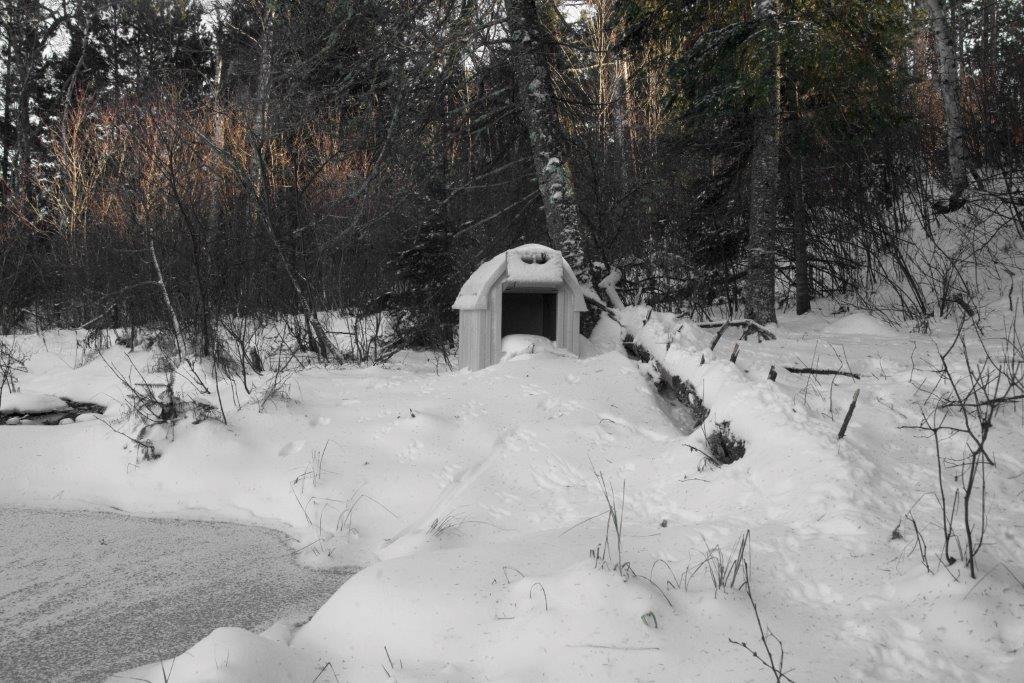
No Quill again. Peggy went out and snapped a picture of the Quill House, getting a look from a deer as she passed by her on the way. 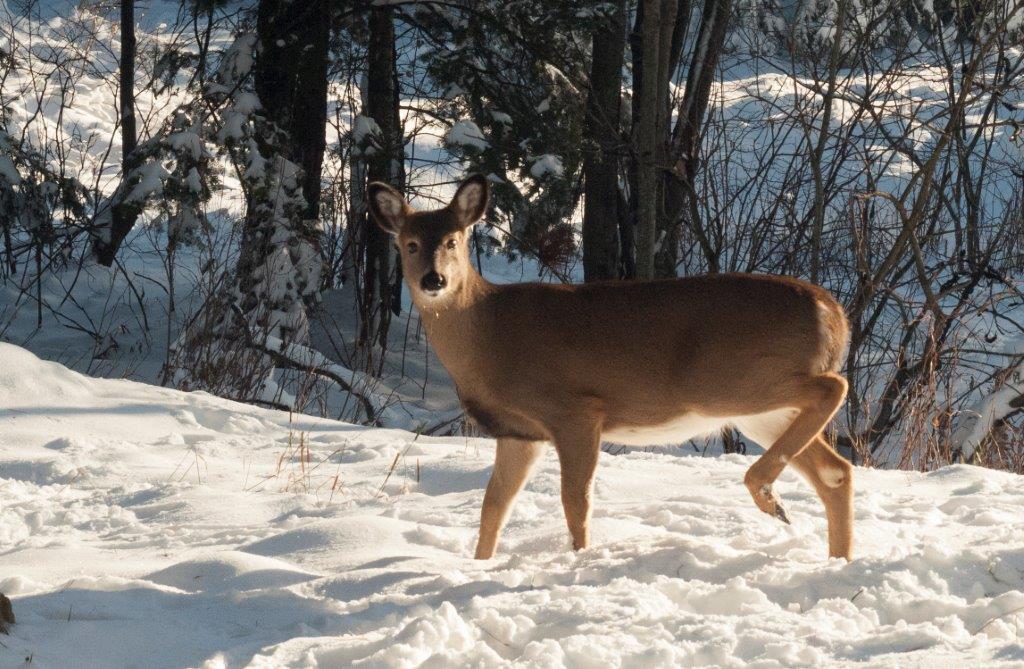 DeerQuill’s House has a lot of red squirrel tracks going past but none stopping in. The bit of frozen lake on the left side of the picture is where Quill stopped to drink a couple times as he passed by. The leaves in front of his house are covered with snow now, and a little mound of snow is in the entryway.
A bit more on orphaned cubs. Back in 1972 when I was still starting out and knew very little, I got a request from the DNR and Duluth Zoo to help with six orphaned cubs whose mothers had been killed in Duluth during a bad food year. The Duluth Zoo had taken them in briefly. There was no rehab facility to take them and the zoo couldn’t keep them. They asked if I would ear-tag and release them in my study area if they brought them up to my headquarters near Isabella, MN. We didn’t have radio-collars for them, and I would not have wanted to radio-collar them anyway. I considered the collars too heavy and bulky to place on a cub, and we didn’t know where they would go. I didn’t want to lose track of a growing cub wearing a radio-collar.
 Quill houseThey drove them to me on September 8—64 miles as the crow flies. I didn’t know where they originated before traveling to Duluth in that bad food year. Some bears come down from Canada in those years. A litter of three weighed 21, 21, and 24 pounds. Looking back, we now know (as I wrote in 1976), that these cubs were very small for that time of year—undoubtedly because of the bad food year—and that they had marginal chances for survival (Rogers, L. L. 1976. Effects of mast and berry crop failures on survival, growth, and reproductive success of black bears in northeastern Minnesota. Trans. North Amer. Wildl. and Natural Resour. Conf. 41:431-438.). We know that two of these made it. The 24-pound male stayed near the release site, so we ended up radio-collaring him. There was a garbage dump a fifth of a mile away, and he nearly doubled his weight (like Quill) before hibernation, despite the bulky collar. He made a nice burrow that was as nice as any other den I’ve seen. By that time, he had lost some weight making the den and fasting for an unknown period, but he still weighed 40 pounds. We caught him the next spring in a barrel trap on May 28, 1973 weighing 29 pounds.
We don’t know much about the 21-pound male. He disappeared until August 10, 1973 when he was electrocuted atop a power pole in the town of Silver Bay 28 miles south of the release site.
 Manny with chickadeesWe don’t know what happened to the 21-pound female, but considering the survival of her littermates overwinter, I suspect she made it, too, though we never got her ear-tag back to prove it. It was the same for the other three that weighed 26, 29, and 30. They had a better chance for survival, but we never got an ear-tag back from them, either. I suspect this male and two females moved far away like the 21-pound male.
A Lily Fan sent this nice video of grizzly bears rubbing trees in Yellowstone National Park like we might see black bears rubbing during the Black Bear Field Courses https://biggeekdad.com/2016/11/dancing-bears/
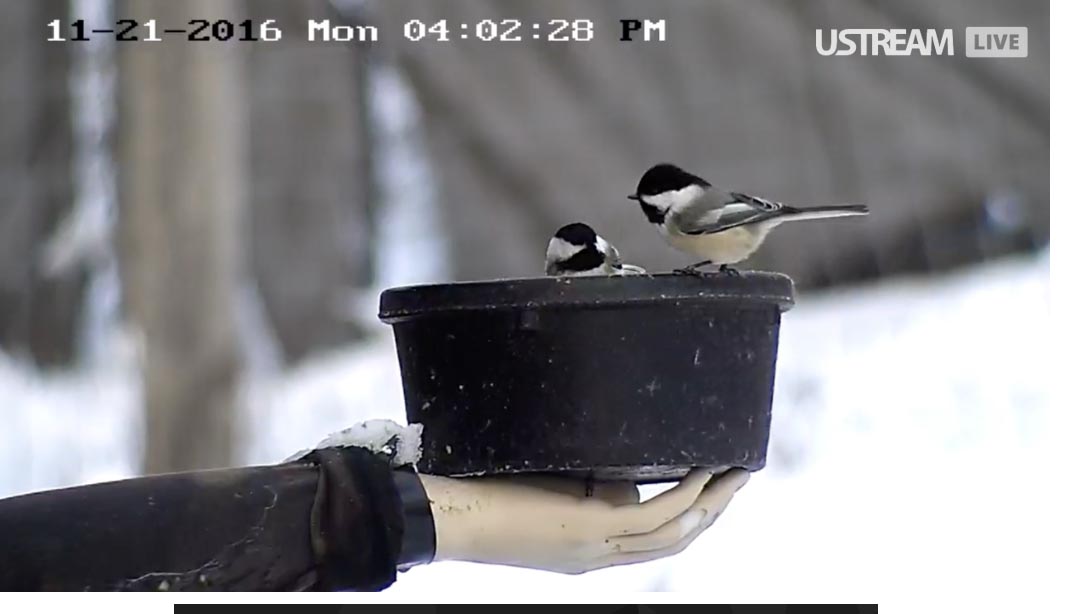
At the Bear Center, the PTZ camera gives good quality pictures at http://www.bear.org/website/live-cameras/live-cameras/ptz-pond-cam-live.html as with these chickadees on the bowl in Manny’s hand. They have begun landing on people’s hands, too.
Thank you again for your generosity on November 17. It’s good to feel your support in improving our educational effectiveness for youth.
Thank you for all you do.
Lynn Rogers, Biologist, Wildlife Research Institute and North American Bear Center