
 Loon sleepingThis 1-minute video clip from June 21, 2009 of June in the pool gives insight into the minds of bears. Jewel and Jordan watched June wade into the pool, walked off, but ran for trees when they heard her splash. One of the cubs (Jewel?) wanted to check what the scary sound was that came from the direction of mom. The presence of mom at the location of the scary sound might have been what gave Jewel the courage to cautiously investigate it. Jewel showed her anxiety, though, by stomp-walking as she approached. She approached behind the cover of a small, bushy tree. When she got to the tree, she didn’t dare come confidently around it into the open. Instead, she showed her anxiety by lunging against the tree and slapping the ground in the direction of the splash as she came around it toward the possible danger. Then, seeing only her mother, she relaxed, came closer, and fell in. https://www.youtube.com/watch?v=zfFl9ob0Z7w
Some people still did not receive the updates after the recent fix. The webmaster found 100 addresses that did not get fixed last week. He fixed them now. Crossing our fingers. Let us know of any problems.
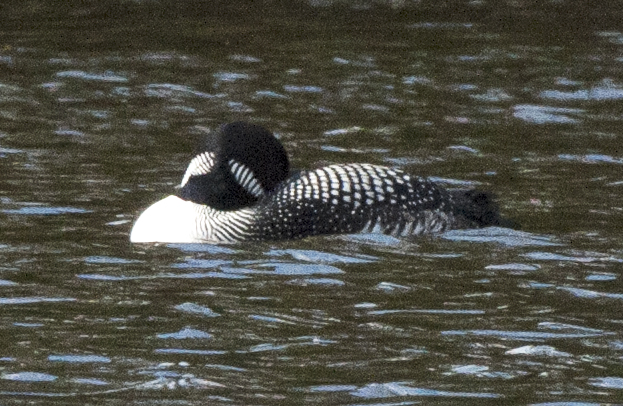
At 12:45 PM, a loon landed on Woods Lake outside the window. It probably was coming in from a long migration flight north from its last stop. It didn’t forage. As of 6:18 PM, it had slept with its head tucked in its feathers for over 5 ½ hours. At 6:39 PM, it gave its first call, showing it was awake.
We received a link to the 12-minute Phoenix radio interview of a couple weeks ago. http://www.breakradioshow.com/archives/breakthrough-entertainments-bear-show-airdate-april-11-2015/
A Lily Fan discovered that legislators voting on the bear-feeding ban are not necessarily aware of the DNR’s continuing litigation against us. When a legislator learned about it from a Lily Fan, she saw the bear-feeding ban in a new light, so it’s worthwhile to mention when writing or talking with legislators.
Another Lily Fan put together talking points that you can send to your legislators verbatim or rewrite in your own words, perhaps adding that the legislation ties to the DNR’s litigation against me. She wrote:
“The Section entitled 97.427 [Feeding Bears] will end up costing Minnesota money and has many negative ramifications. Please vote Against this Section and move to have it removed from SF1303 as it was from its companion Bill HF1406.
Consider the negative impacts on Minnesotans should the section titled 97.427 [Feeding Bears] of Bill SF1303 be included:
- Minnesotans would not be allowed to feed bears on their property, but bear hunters would still be allowed to do so on public and private lands, unfairly restricting the rights of the public in favor of a special interest group admittedly favored by the DNR. If it would be illegal for all Minnesotans to feed bears, then it should be illegal for hunters to do so.
- Would criminally punish Minnesotans for feeding birds should they fail to eliminate spilled bird seed; not have bird feeders placed where the DNR mandates, or at certain heights; not made out of bear resistant materials. Subjecting Minnesotans to criminal misdemeanor charges, fines, possible jail time and a criminal record.
- Fruit tree and garden owners would be criminalized if bears are attracted and eat.
- Creating a neighbor vs neighbor social dynamic to report potential "violators,” making them the eyes and ears of the new law.
- Additional cost to the State for increased DNR COs/ Law Enforcement personnel.
- Added cost and burden to our judicial system to prosecute citizens cited for feeding bears.
- Potential negative economic impact to retailers by reducing bird seed and feeding supply purchases. Businesses such as Wild Birds Unlimited could go out of business in Minnesota.
- Increases the role of State Government by invading Minnesotans’ private lives and infringes on our rights by dictating our care and enjoyment of wildlife on our property.
To single out and make it illegal to feed bears, while being able to feed all other wildlife, is going too far. The bear feeding section of the Bill should never be made part of the Hunting Statute 97B. It’s unfair to penalize Minnesotans while giving special privilege to bear hunters.
Through the Section entitled "97.427 [Feeding Bears]" in the Omnibus Senate Bill SF1303, the DNR is attempting to destroy the historic tradition of bear feeding with no proof to support their claim of a public safety issue. Feeding wildlife (bears included) is a Minnesota tradition. One with less of a safety issue than hunting. The DNR recorded 57 hunting fatalities from 1990 to 2012, an average of about 2.5 per year. There were a total of 634 hunting injury or fatality incidents during that time, for an average of nearly 28 per year, according to DNR stats. (Bemidji Pioneer, Oct. 12, 2013). During the last 28 years, since 1987, there have only been 12 black bear attacks or “potential attacks” in Minnesota! 12! (http://www.startribune.com/local/blogs/277907611.html) Most were not official attacks causing injury, but warning bluff charges. A person is more likely to get struck by lightning than be attacked by a black bear.
The DNR has never claimed a "public safety" issue during the last 50 years. With the significant decline in nuisance bear complaints, per DNR annual bear research reports, why would the DNR NOW be justified in pushing for a statewide law to make feeding bears illegal when there is less of a problem NOW than ever before? Karen Noyce, former DNR bear researcher, in a Brainerd Dispatch article on Bears (July 15, 2000), stated ". . . nuisance complaints in the Grand Rapids region have been far below average to date. "What drives early nuisance activity . . . doesn't correlate with the overall population as far as we can tell. It's probably related to food supplies . . . Later in the summer we can correlate nuisance activity with food supplies, and hunting success too. The availability of fruits and acorns definitely has an effect on whether bears come into people's yards and how many hunters can expect to see at their bait stations." In a December 2002 article: "Pacelle (Senior V.P. HSUS) said it is inconsistent for the U.S. Forest Service and federal agencies to warn people against feeding animals, but allow hunters to put out food for bears. "There is some truth to that," conceded Noyce, the Minnesota state bear researcher. "I won't say baiting doesn't contribute to bears habituating to human scent. I'm sure it does."
"This Bill Section is bad for Minnesotans and bad for black bears.”
Aside from the bill, as I work on exhibits for the Northwoods Ecology Hall, I am also thinking about our next goal. I want to write a book that covers a range of topics with June’s life at the core of it. I want to go with the wave of the future in having it be a Kindle book or ebook with links to video that Sue is currently cataloguing and to clips from the Den Cam archives. I want readers to learn directly from the bears by watching video of events we describe. People can then see for themselves whether they agree with our descriptions and interpretations or not. What they see with their own eyes, officials and “experts” cannot refute. Lily Fans know what I mean. I believe it is the most effective way for large audiences to learn. It will be more effective than simply reading words, watching documentaries, or hearing lectures. It will be similar to what Lily Fans have experienced watching Den Cams and video clips. Together, we have seen for ourselves and learned more about black bears than has been possible for most biologists and other wildlife authorities. This could be huge for bears and life-changing for people. Lily Fans can relate. Learning the truth from the bears themselves makes people want to share. That’s what has made Lily Fans such a force.
Legislators have not had that opportunity. What worries us is that they will be voting on the bear-feeding ban based on old misconceptions. I don’t know if we can share the facts with them in time, and I don’t know if they will believe us over the propaganda the DNR has been putting out through the media these past couple years.
Thank you for all you do.
Lynn Rogers, Biologist, Wildlife Research Institute and North American Bear Center