
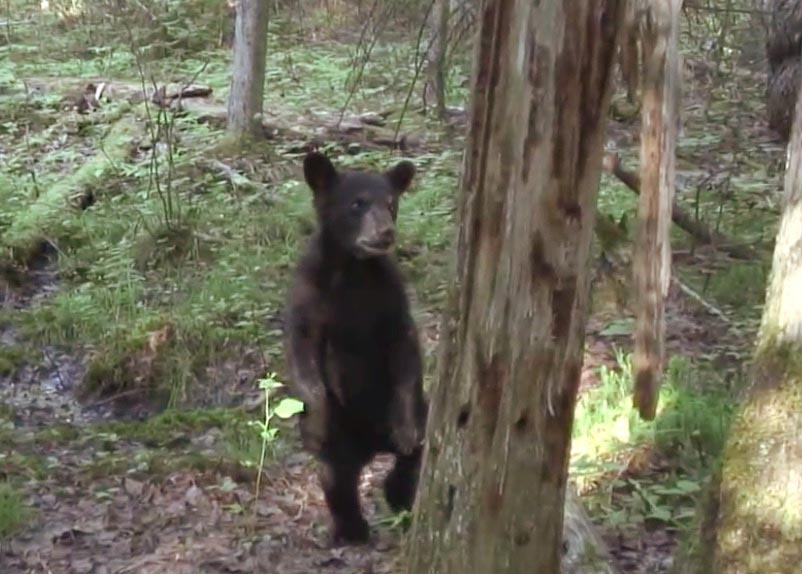
 Bud eyeing the burl - 6-22-07In this 1 minute, 20 second video clip from June 22, 2007, Bud gives insight into the mind of a 5-month-old cub https://youtu.be/DXJ6JcCWzSI.
Little Bud has always been curious. He’d often be off investigating while Lily and Cal played near their mother June. That situation unfolded again this day. As Lily and Cal began to play, Bud took a walk.
Always on the alert, he glimpsed something that sent him huffing to the security of a cedar tree. He’d seen a burl on the side of a tree about 5 feet up. A burl is a bulbous, wood protrusion that results from stress, virus, or fungus. 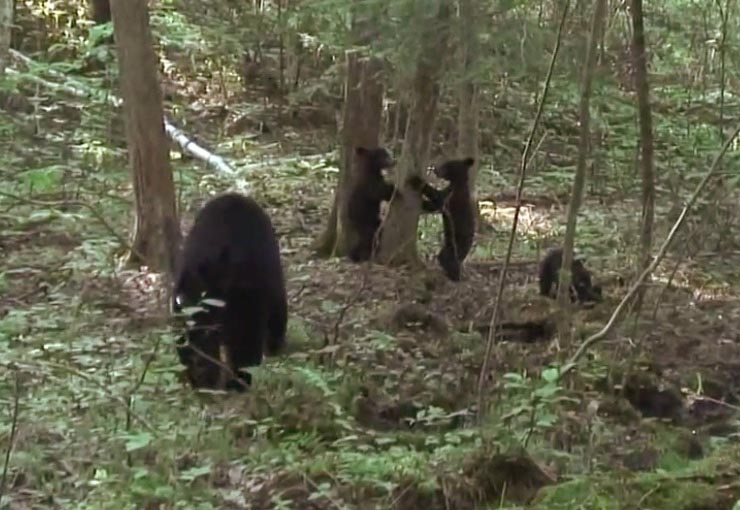 June's family - 6-22-2007It’s covered with bark the same as the rest of the trunk. But the shape of this burl probably looked like an animal clinging to the side of the tree. Bud ogled it as he stood gripping the tree he’d run to.
One would think that the whole woods would look strange to a cub less than 10 weeks out of a den; but in those 10 weeks, Bud had seen enough trees to spot a difference. Maybe bears are born with certain search images that spell danger. It took him no more than a glance to notice the burl and retreat to safety.
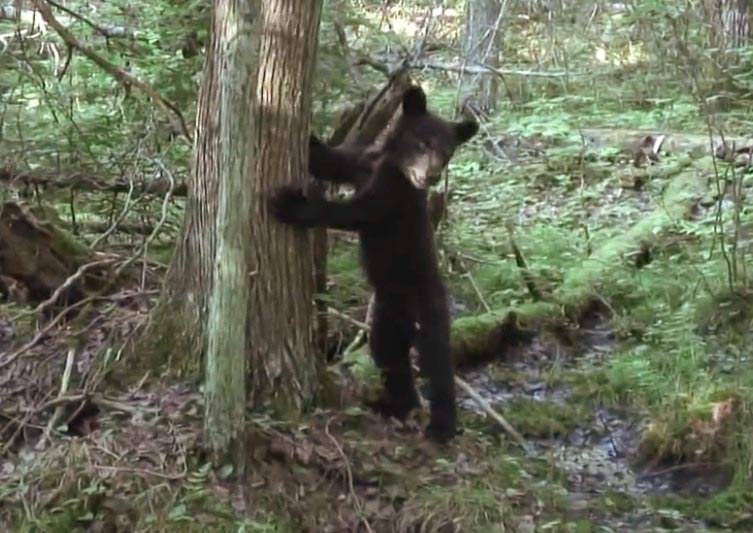 Bud, feeling safer at a tree - 6-22-2007After a few seconds, Bud left his tree and moved hesitantly toward the burl. Of course, a burl has no unusual smell, no sound, and no movement, so it was strictly the shape that spooked him. As he approached it, his face took on a look of anxiety as he turned and leaped partway up his refuge tree.
Looking toward the burl, he descended and approached it again. With a more confident look, he stood and eyed the shape that had spooked him. He was proceeding around it to continue his walk when the video clip ended. I suspect he more quickly identified harmless burls after that. We’ve never seen an older bear react to a burl.
Thank you for all you do.
Lynn Rogers, Biologist, Wildlife Research Institute and North American Bear Center