
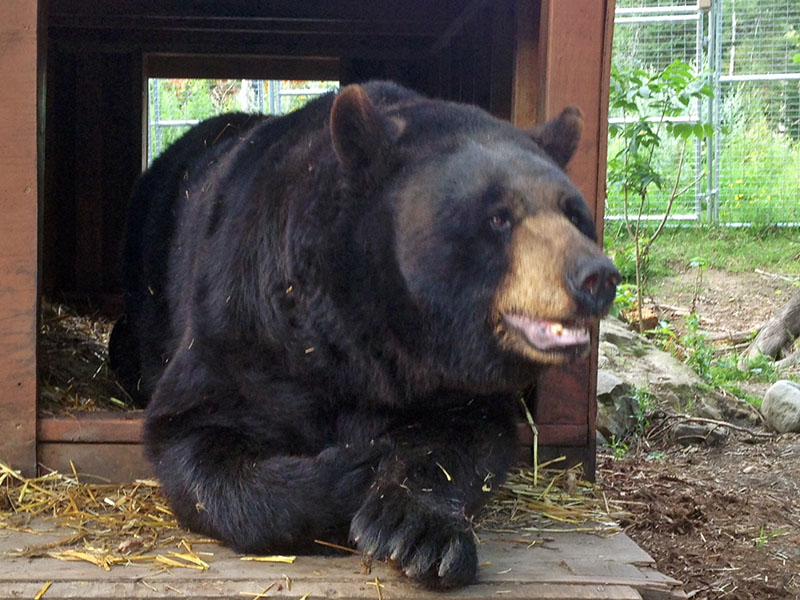
 TedOn Ted, we’re happy he has a good appetite and is making his usual friendly sounds today after the veterinary procedures yesterday afternoon.
Do Fed Bears Approach People?
For over a year, Minnesota Department of Natural Resources officials without firsthand knowledge have been telling the public that our feeding teaches bears to approach people for food. Repeating that line as often as they did was effective. It scared people and apparently swayed the judge despite the fact that the DNR did not produce one witness to back up their claim. A scared witness expressed her fear that a fed bear would someday come up to her or her children, and a resident said she wouldn’t dare let a child wander down by the lake with an ice cream cone.
We doubt if the community would have allowed a dozen households to continue feeding bears for over 50 years if it resulted in unwanted approaches away from the feeding stations.
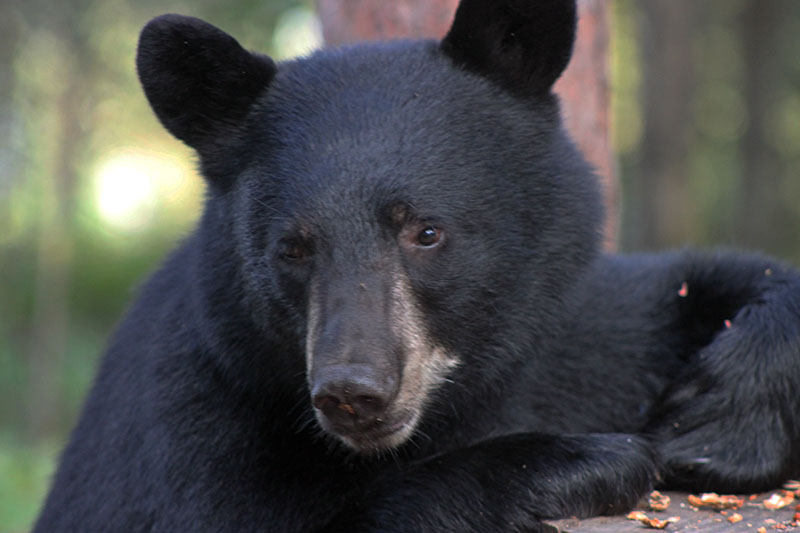 Fern winksFrom our observations, we know that the bears we see at community feeding stations avoid people elsewhere. We know from interviewing hikers who saw few bears and had no problems while walking 2-5 miles per day on forest trails in our study area for over a decade. We also know it from people who walk their dogs, run, or pick blueberries. We know it from children having lemonade stands with no problem 300 yards from one of the biggest feeding stations in the community. Today, our nearest neighbor, 96 yards away (building to building) told us he has yet to see a bear this year. Another neighbor emailed us that Fern showed up at their feeding station as they were barbecuing, saying “Never a worry about the bears getting into the barbecue.” So much here is contrary to common beliefs.
We are beginning a tougher test of the DNR claim that fed bears approach people away from the feeding stations. We will keep track of bear encounters as we map the network of well-used forest bear trails that surround the community feeding stations. To map the bear trails in these high-use areas, we’ll walk them carrying GPS devices that will let us transfer the data to a map of the area. This will require volunteers. What makes it interesting is that this is the time of hyperphagia when extra hungry bears, many of them used to being hand-fed, are packing on the pounds for hibernation. The mapping areas are all close in around the community. To maximize chances of encounters, we’ll do much of the mapping around dawn and dusk when the bears are most active.
Will the bears approach us and/or volunteers? Will resting bears seek out humans they smell or hear passing by?
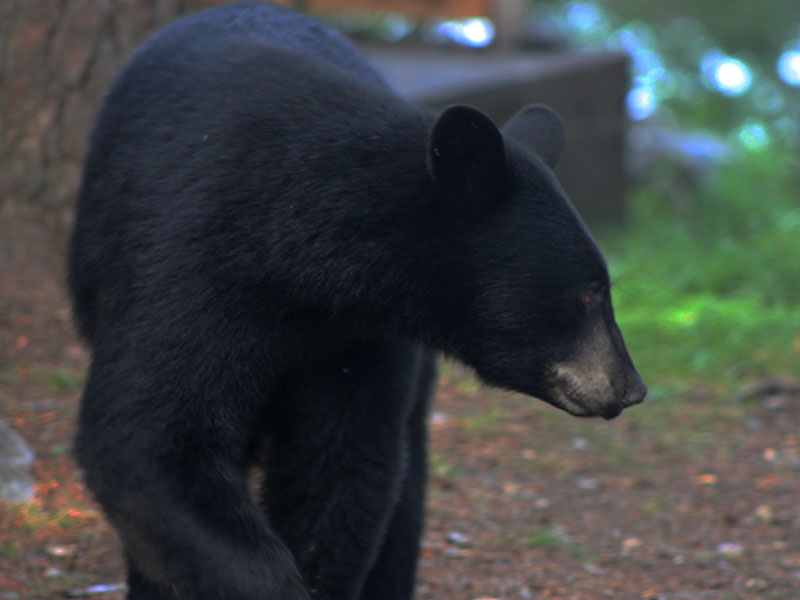 FernWe know from our many previous hours in those high-use areas that the same bears that are fed and petted at the community feeding stations avoided us and were wary and shy elsewhere. That held true whether the bears were young or old, male or female. We tried to test this a bit in the past by quietly walking upwind toward resting radio-collared bears without speaking to let them know who we were. We typically heard their signals fade away without a glimpse. Most of those were females. To see how a big, confident male would respond, we put a radio on B B King, one of the most trusting bears we knew at the community feeding stations. Same story.
We suspect that people who participate in this study will see few bears.
The study is important in refuting one of the most widely held misconceptions about black bears. It is a misconception that gets bears killed by officials if they think a bear has lost some of its fear of people. Many believe that a bear that loses some of its fear of people is more likely to attack. That belief assumes that bears would love to attack us if they only dared, and bears that lose their fear of people would then dare to do so. In truth, the literature, our experience, and the experience of Charlie Russell indicate that bears that are less fearful of people feel less defensive toward them. That’s what allows us to safely do what we do. That’s why none of the bear attacks in Minnesota have been in or around Eagles Nest Community where bears have been fed for over 50 years.
Thank you for all you do.
—Lynn Rogers, Biologist, Wildlife Research Institute and North American Bear Center
All photos taken today unless otherwise noted.