
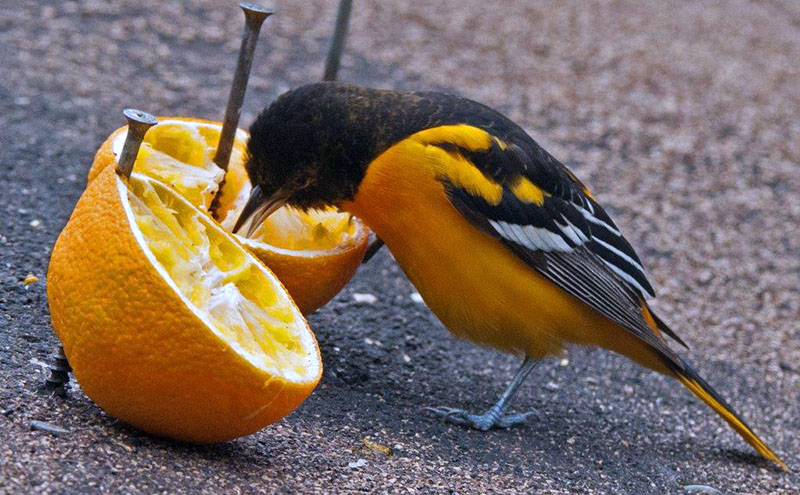
 Baltimore OrioleAs of this evening at 7:04 PM, Lily, Eli, and Ellie are still together. Same for Bow and her two male yearlings and for RC and her two remaining female yearlings. So all of our speculations about Lily splitting were wrong. That’s why we check and verify.
At the Bear Center, it was good to see one of Bob Dylan’s band members and reminisce with a former Nature Conservancy official who worked with Lynn to preserve a mile-long oak stand, unique in this region, and nearly double the size of Tetegouche State Park some years back.
Nature Notes: We seldom see Orioles here, but the oranges we put out attracted a beautiful male Baltimore Oriole today.
Yesterday, May 20, a pair of Hooded Mergansers flew by the WRI Cabin as the male escorted the female to the nest box, which she flew into. This was the first time we saw her enter the box. On that same date (May 20) in 2007, she was already sitting on 12 eggs. If we see her fly out to eat, we’ll check the number of eggs.
The Pileated Woodpecker pair is intriguing. The nest tree is a little over 30 feet from the WRI cabin. This evening, the female was foraging on the ground at the base of that tree. At 7:55 PM, she flew up onto a branch a big red pine, called, and within 20 seconds the male flew in and mated with her. Both flew off a few minutes later. At 8:08 PM, the male returned and immediately entered the nest hole for the night. This is the nest where we heard one of them pecking inside the hole on May 14. They peck shavings from the walls of their hole to make a soft bottom to lay the eggs on. Maybe that’s what was happening. It is the female that does most of the excavating. Yesterday, the male, the sex that broods the eggs at night, was in the nest looking out. One would think they had eggs except for the fact that they mated this evening. When they used this nest hole back in 2006, the young were already big enough to be seen looking out the nest hole on May 31. That’s after about 18 days of incubation of the eggs and several days into the 26-28 days between hatching and fledging.
The nest was excavated that year (2006). Three young flew from the nest a few days before June 21—Sue has the exact date. We will be better able to put our notes in perspective when we determine when they laid their eggs. We can eventually approximate that date by counting back 15-18 days (the incubation period) from the first day we see the parents bringing food to the nest and by counting back an additional 26-28 days from the day the young leave the nest. More tomorrow.
We apologize for the lack of notification that last night’s update couldn’t be posted until this morning.
Thank you for all you do.
—Lynn Rogers and Sue Mansfield, Biologists, Wildlife Research Institute and North American Bear Center