
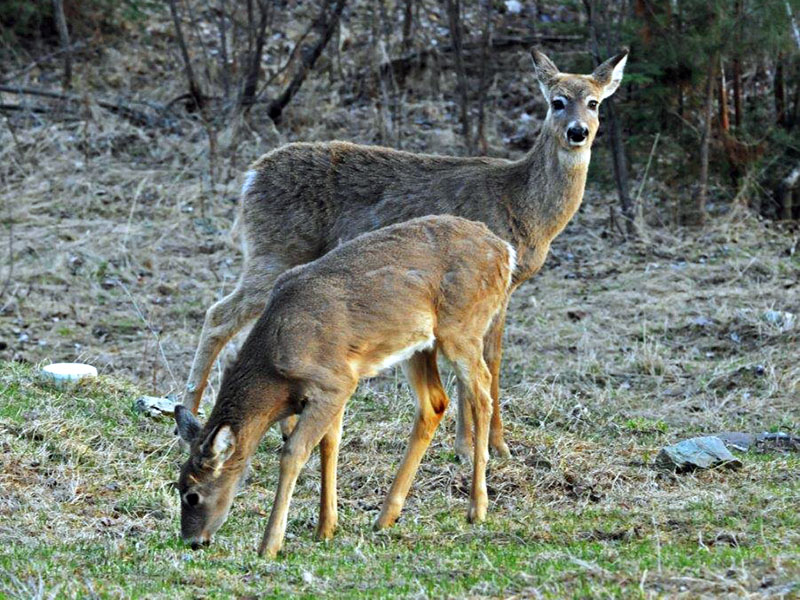
 Deer eating grassExcitement builds every year at this time as spring takes hold. Things are changing fast. Ice is disappearing from the shallower lakes and turning black on the deeper ones. Ice completely disappeared from Little Woods Lake today at the WRI. The next shallowest lake in the area, Robinson Lake is over half open and attracting bald eagles and herring gulls to the dead fish that are becoming available as the ice melts. Ten bald eagles were on the ice and in the surrounding trees there today. In the open portion of that lake, the first large lake to open, ring-necked ducks, baldpate ducks, and mallards paused in their migrations. Lakes farther north are undoubtedly still frozen.
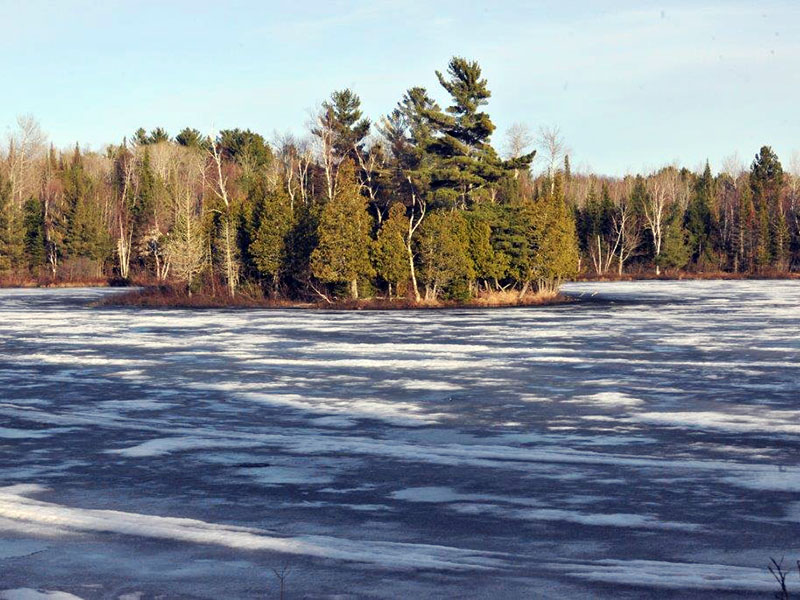 Ice turning black
on Eagles Nest Lake OneIn dense, shaded forest, snow is now down to patches. The shaded stretch of road that got us stuck in the snow yesterday was drivable with 4-wheel drive this afternoon. In open forest and non-forest, snow is gone and grass is coming up attracting both deer and bears. 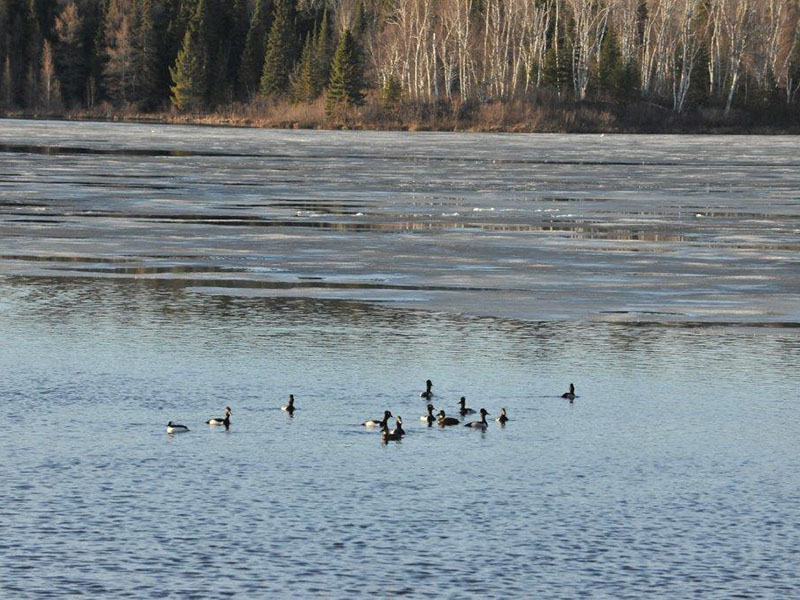 Ringneck and Baldpate ducks
on Robinson LakeAster made her first big move of the year, walking a mile to and open area she had visited with her mother June. It pays for daughters to remain in their mothers’ territories and take advantage of the food locations they learned from their mothers.
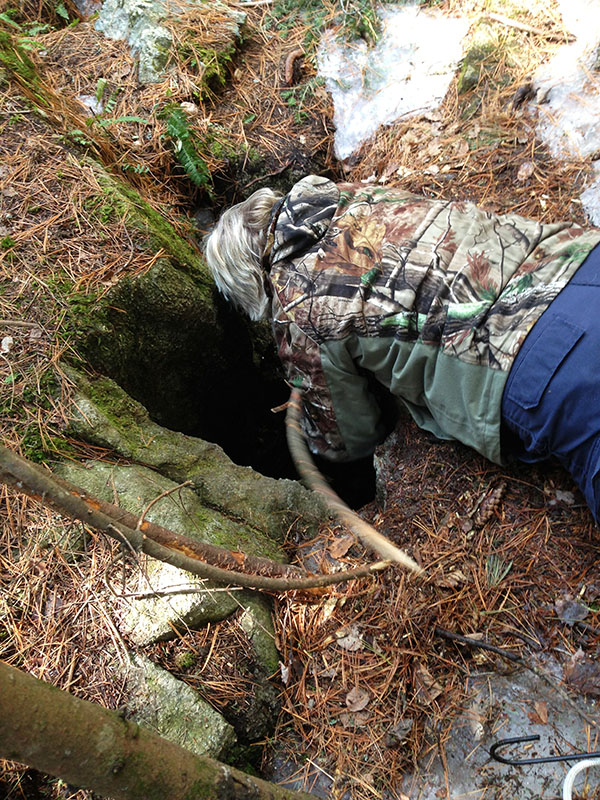 Fishing for the trail camJuliet experienced drama today, and we don’t know what it was. She may have just been exploring while her cubs slept safely up the white pine refuge tree where we visited them yesterday afternoon. Between 8:52 and 10:01 this morning, she made a circuitous 0.71 mile move from her white pine to a point 0.34 mile south of it. That’s 0.71 mile in 69 minutes (0.6 MPH), which is casual walking speed. Usual walking speed is about 1 MPH. Then she zipped 0.34 mile back to the refuge tree in only 12 minutes—1.7 MPH. That’s hurrying.
 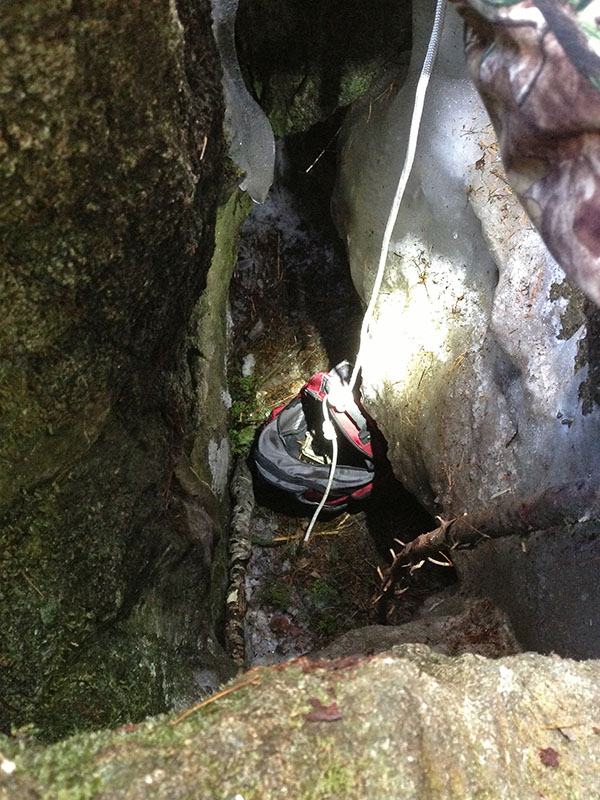 Backpack in den loaded
with trail camDid she hear the cubs calling? She didn’t stay with the cubs more than a minute or so. Between 10:13 and 10:22 AM, she retraced her route back to where she’d been and farther, covering 0.4 mile in only 9 minutes (2.7 MPH). That’s 2-3 times walking speed. Why the hurry? Then she returned to the cubs just as fast, covering the 0.4 mile in 10 minutes (by 10:32 AM).
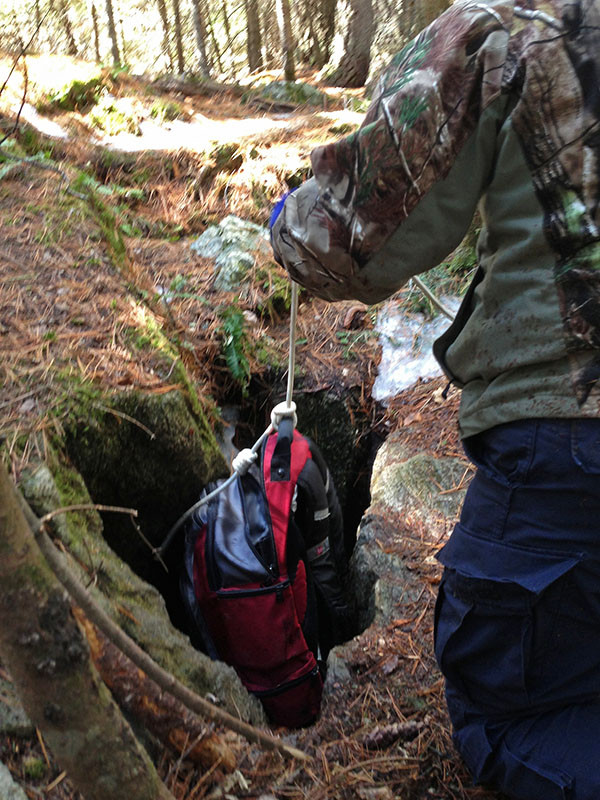 Success!We wish we’d been there to see what prompted such vigorous activity. But then, we’d never have been able to keep up with her. At least we could have heard the cubs calling her back, if that’s what happened. Whatever the reason for the fast moves, she’d had her workout for the day and spent the rest of the day near the tree. We know from experience that mother bears can come fast from afar when their cubs start squawking.
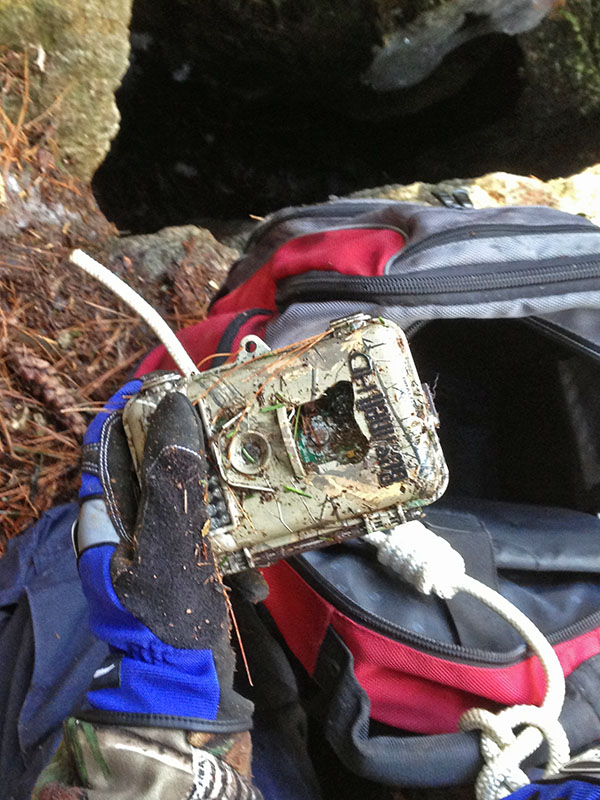 Trashed trail camSue and Bec set out to retrieve the trail cam from Lily’s deep rock den. They found the walls of the den covered with thick ice—making climbing into it hazardous. To further complicate things, the trail cam was no longer visible in the den. Undeterred, they found a long stick and began poking around in the 7-foot deep den. They located the cam under some balsam bough bedding—only to find another complication.
 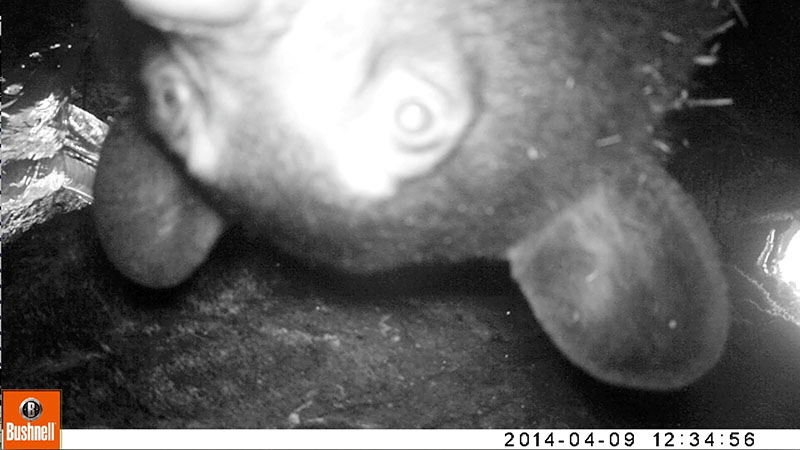 Bear selfieThe mounting strap was no longer attached—meaning there was nothing on the cam to snag in order to pull it up. Bec emptied her backpack, tied a rope to it, lowered it into the den, carefully guided the cam into the pack with the long stick, and successfully hauled backpack and trail cam out. The trail cam was trashed, but the memory card held a treasure trove of videos from outside and inside the den.
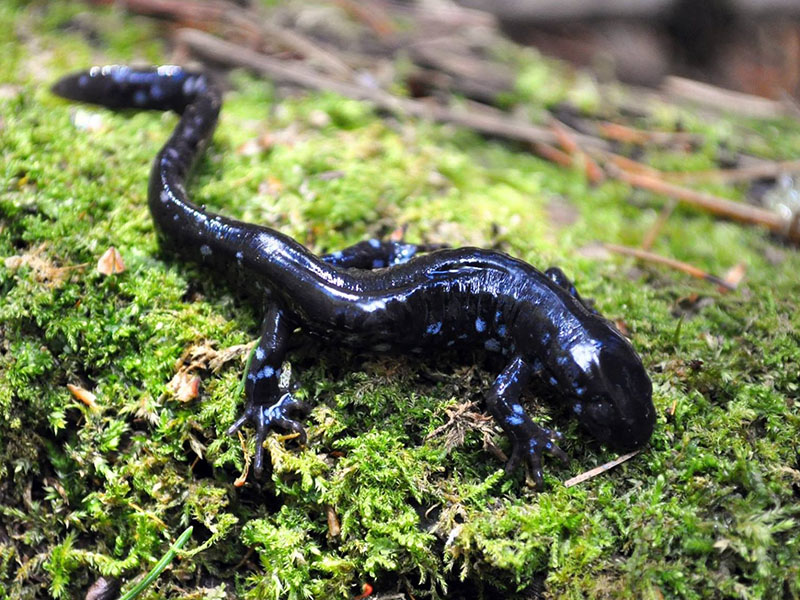 Blue-spot salamanderA beautiful blue-spot salamander was found among balsam bough bedding that was hauled up out of the den.
Thank you for all you do.
—Lynn Rogers and Sue Mansfield, Biologists, Wildlife Research Institute and North American Bear Center