
 Honey All is well with the radio-collared bears and their families. Sue and Field Assistant Bec attempted to catch up to Dot today to gave her a GPS, but Dot is not used to either of them so she and her yearlings avoided them. Dot was in the first litter to be born and studied here back in 2000. She is the daughter of Blackheart and the granddaughter of Shadow, the 26-year-old matriarch. She is the older sister of Braveheart, who we caught up to yesterday.
At the Bear Center, Ted, Lucky, and Honey are intrigued with new toys filled with food. They manipulate them to make the food fall out of little holes.
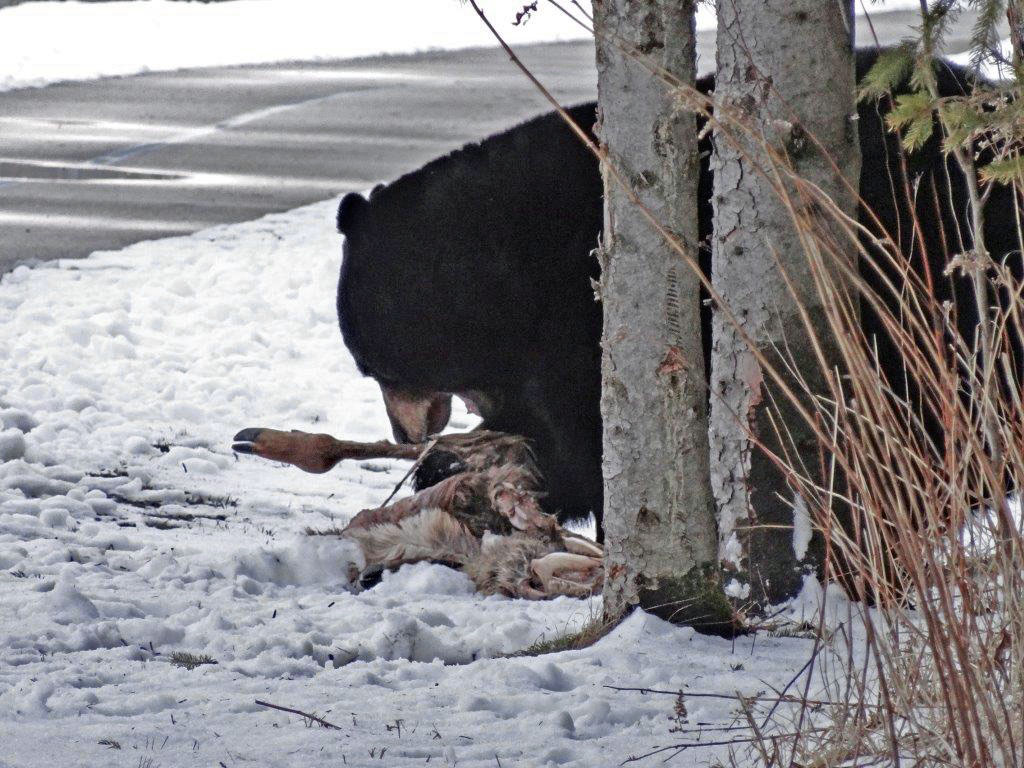 Duluth bear eating deer - April 15, 2013Today, we received a picture of the Duluth bear from April 15 as it ate a road-killed deer very close to a blacktopped trail that is heavily used by joggers, bikers, and people walking dogs. The Lily Fan said the bear “didn't pay attention to people and didn't care that people were strolling on by.”
 Katmai - 2006Where bears get used to seeing people, they don’t become more aggressive, they become more accepting—even grizzly bears. Where grizzlies see a lot of harmless people in Alaska, they walk past photographers like they weren’t there. And no, that is not how Tim Treadwell got killed and eaten. That’s another story. Sometimes Tim behaved in non-threatening ways toward the bears, like the photographer in the picture, and sometimes he was a “Samurai Warrior,” as he said in the movie Grizzly Man. We believe a person has to be careful being a Samurai with a grizzly. Although we don’t recommend close encounters like in this picture, grizzlies don’t pass this close to people unless they are comfortable doing it like this bear apparently was. Each bear has its own personality and degree of comfort.
Although grizzlies are 26 times more dangerous than black bears, they still aren’t as bad as their reputation. Same with polar bears whose aversion to risk is more like a black bear’s than a grizzly’s. Polar bears can’t catch seals and survive if they get hurt, but grizzlies can continue to graze, so polar bears have to be more careful. The idea that polar bears stalk humans is way overblown, although Lynn met a man in Churchill who was later killed by a polar bear when he came into a building where a polar bear was raiding a freezer after a fire. Native Siberians and Researcher Nikita Ovsianikov deter polar bears with sticks. Nikita has had over a thousand encounters. The Bear Center has a lot more on these magnificent animals. Not that a person should be reckless around these powerful species, but none of them are as ferocious as most people think.
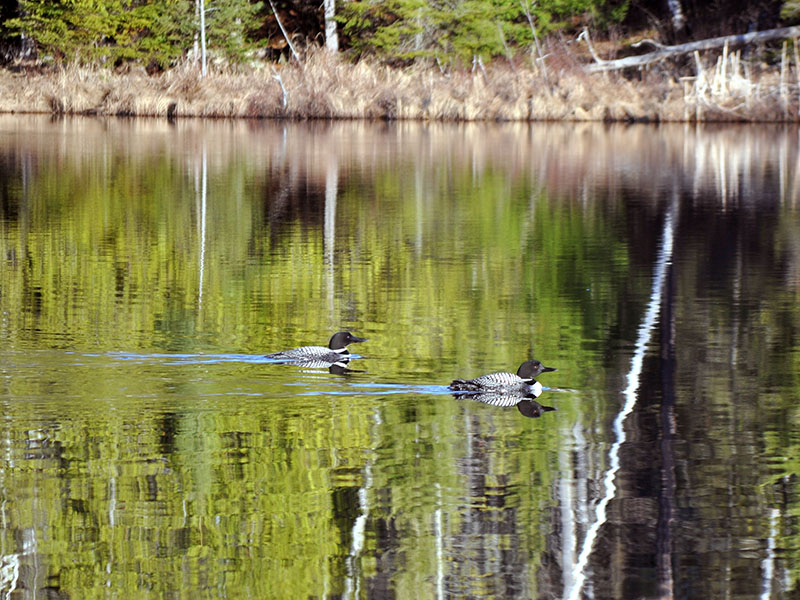 Loons on Woods LakeAll the above leads into the email Buck Wilde sent Lynn today, reminding Lynn about the highly anticipated Great Bear Stake-Out TV program on Discovery Channel at 9 PM Eastern and Pacific Time and 8 PM Central Time. It features Chris Morgan, Buck Wilde, and Brad Josephs, all fellow guides with Lynn on John Rogers’ (no relation) boat in Alaska (www.katmaibears.com). All are good guys. Chris Morgan provided video for use in the Bear Center. Brad Josephs guided the grizzly viewing group a couple years back so John Rogers could contribute $10,000 of the proceeds to the Bear Center. Buck Wilde wrote two of the articles for our Bear Encounters Book at http://www.bear.org/website/books/product/7718-bear-encounters.html.
 Herring GullWe’re not surprised that this program, which is supposed to help people better understand and appreciate these bears and their environment, was filmed with the help of John Rogers and his boat. Lynn guided for John each year during 1996 through 2006 after learning from Erwin and Peggy Bauer that John and his boat provide the best way to see grizzly/brown bears (Ursus arctos) in a variety of settings and circumstances. Lynn is hoping to see familiar locations like Hallo Bay, Geographic Harbor, Kukak Bay, Kaflia Bay, Ninagiak Island, Swikshak Lagoon, and others in the program. Some of these places have other names. Swikshak Lagoon was once known as The Forbidden Place because so many grizzlies gather there to graze on the meadows. Now people have a different attitude about the bears there and calmly walk among them as the bears ignore them and go about their lives. Seeing the reactions of the grizzlies there contributed to our confidence to work with black bears like we do. If black bears were like most people have long thought, we couldn’t do what we do.
Our trusting Herring Gull (Larus argentatus) friend arrived back from migration today and landed where he/she is used to getting suet.
Thank you for all you do.
—Lynn Rogers and Sue Mansfield, Biologists, Wildlife Research Institute and North American Bear Center
All photos taken today unless otherwise noted.