
 Juliet peers from den - Oct 14, 2012The hunting season ended October 14, and no radio-collared bears were taken. Sue is back after happy days of family and friends in New Hampshire.
Meanwhile, Jim Stroner and Lynn visited Juliet and removed her GPS unit and ribbons for the winter. She only came partway out to let us work on her radio-collar surrounded by mounds of leaves that she, Sam, Sybil, and Sophie had raked to the entrance.
 Aster's bed - Oct 14, 2012Later that day, reaching Aster’s den was what we call a ‘death march.’ Even though it was only 0.6 mile as the crow flies, steep hills and deadfalls made it seem farther. Over each hill, we thought the signal would be louder, and finally it was. Shortly, we saw Aster watching and listening next to a bed she had raked days before. The bed was firmly packed and worn.
 Aster's den - Oct 14, 2012Eleven feet away was a den that was hard to believe little yearling Aster could have dug. It was about 10 feet long in rocky soil with a huge mound of rocky soil at the entrance. We caught her at the stage of construction when she just finished digging and had begun raking up bedding. No bedding was in the den yet. Two big balls of clubmoss were near the entrance. If she continues to rake in bedmoss, this deep den could end up as warm and snug as any den we’ve seen. We’ll see if snow closes the entrance. If it does, the den temperature will be similar to the surrounding soil—around freezing. If the entrance stays open, the temperature will be similar to the ambient temperatures, which dips far below zero (F) on some days.
 Inside Aster's den - Oct 14, 2012What a contrast between the dug dens of Aster and Jewel. Aster’s den in rocky soil likely took days to dig, considering the well worn look of her bed. Jewel’s den was likely made in a matter of hours in the purest sandy soil we’ve seen around here. It is only a half mile from Jewel’s sandy den of last year. We don’t know of any sandy area like that in Aster’s range.
 Aster approaches cautiously...with one eye on Lynn and one on Jim - Oct 14, 2012Aster looked stiff as she very slowly walked 40 feet away. She was cautious—not wanting to be pressed before she could pump blood into her legs and gain capability. We waited. We took quiet, slow steps toward her when she looked away. We wanted to be close enough for her to easily identify us. Eventually, she was ready. She slowly came closer as we tossed hazelnuts ever closer to us. Finally, she clambered over a log and let us remove her ribbons and loosen her collar. She was almost as calm as Juliet through the pulling and twisting of the collar. Her trust comes from our walking with her mother June when Aster was a cub last year and a yearling this spring. She is living unnoticed deep in Bear Head Lake State Park.
We felt very privileged to be accepted by her and be able to observe this stage of her den preparations.
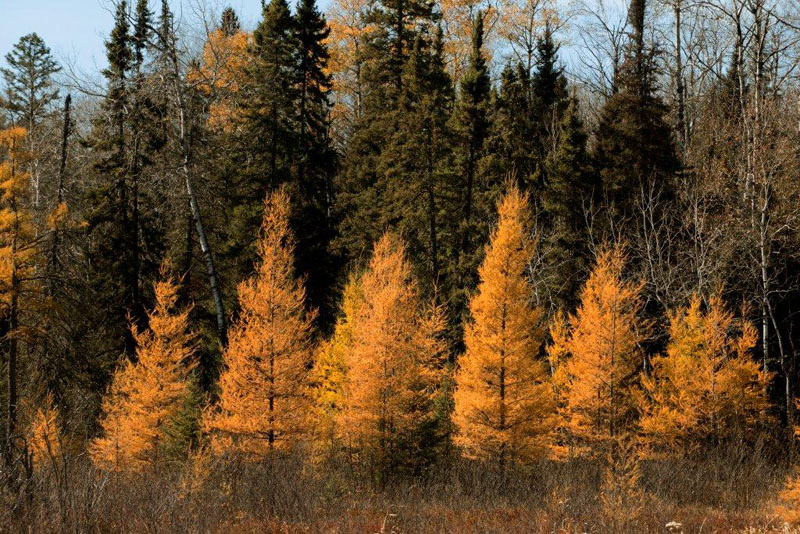 Tamaracks - Oct 16, 2012
A Lily Fan sent us a link to a fascinating article in the Calgary Herald about our friend Charlie Russell’s interactions with brown bears in Russia (http://tinyurl.com/calgaryherald-charlierussell). The article mentions a presentation Charlie will be making at Festival Place in Edmonton on Wednesday, October 17. Charlie knows brown behavior like no one else. We know his presentation will be stellar.
We thank everyone for your supporting words and deeds through the hunting season and your donations for the Hope Learning Center.
Thank you for all you do.
—Lynn Rogers and Sue Mansfield, Biologists, Wildlife Research Institute and North American Bear Center