
 Sunrise on Eagles Nest Lake One - Sept 25, 2012 Dawn this morning was beautiful although we missed the greatest beauty when the clouds were orange over half the sky.
Overnight, 10-year-old Braveheart’s signal disappeared, so we searched her territory today and found her in a den. It was another root mound from a leaning cedar. She didn’t have to dig the den—just rake bedding into the ready-made one. She came out for a handful of nuts and let us remove her GPS unit and ribbons. She will have cubs this January—probably 3 if she holds to her usual—and we’d rather she didn’t have anything extra on her collar to possibly get in the way.
 Braveheart in den - Sept 25, 2012Braveheart’s heart rate became elevated (80/minute) when she went on tense alert with ears and eyes focused toward an unknown sound in the distance. Then it fell to 72 as she relaxed. We wonder what the heart rate would have been if we could have measured it in the den before she came out to let us do the work. We remember a cub whose heart rate fell to 22/minute as it slept outside a den in fall before settling in.
 Braveheart's den - Sept 25, 2012We clambered through a tangle of downed trees and water in cedar/alder swamps to get to Braveheart’s den—then realized we were close to a narrow woods road that we could have driven in on. Needless to say, we walked back on the road. It was four times as far but took half the time—plus we got to soak in the amazing fall colors along the way.
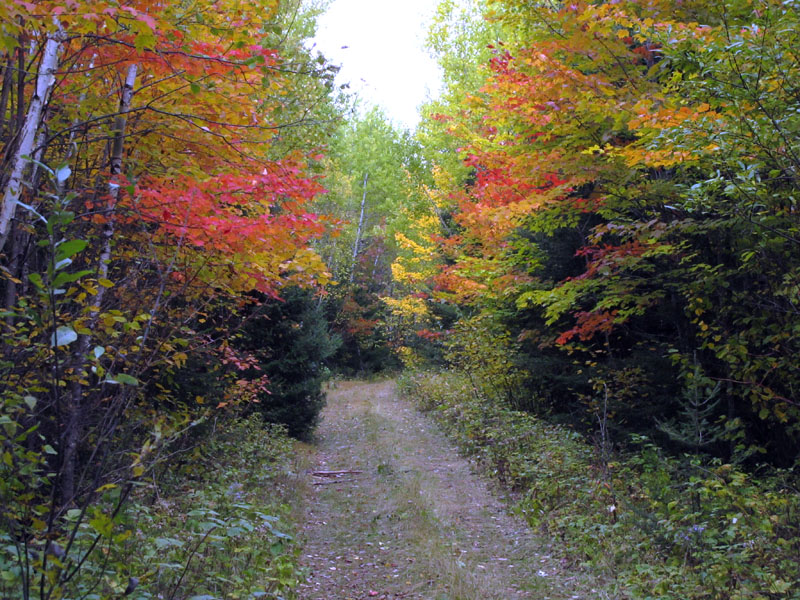 Trail back to van - Sept 25, 2012
We got a rough location on 3-year-old Star but it was too late in the day to search further. She’s moved a mile or so since her GPS batteries expired a couple days ago. We’ll continue searching tomorrow.
We listened to Lily’s signal. Faith was seen. All indications are that the radio-collared bears are safe.
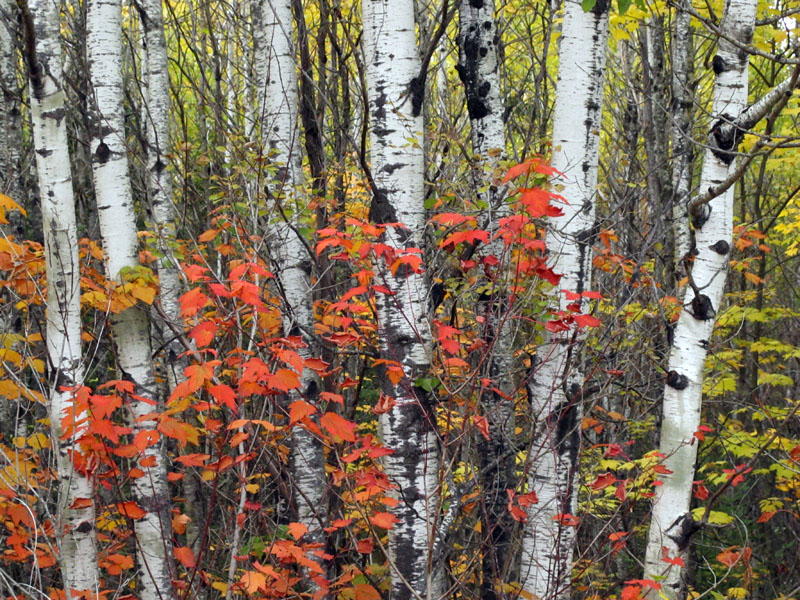
 Fall colors - Sept 25, 2012We saw an article about a homeowner shooting a 300-pound bear that was on his deck somewhere in southeastern Minnesota (http://postbulletin.com/news/stories/display.php?id=1508876). There are very few bears in southeastern Minnesota. Where people are not used to bears, they buy into the sensationalized media image and official warnings about bears and refuse to coexist with animals they fear. It is what most limits bears’ ability to expand their range. The great fear expressed in the article is an indicator of the need for education.
 Fall colors - Sept 25, 2012
The homeowner mentioned that the bear had less than an inch of belly fat even though the bear weighed about 300 pounds and that the bear would likely have starved over winter. Actually, most of the fat on a bear lies like a thick blanket over the back, giving it insulation as it sleeps on its belly with its head tucked under the chest. The fat becomes thinner on the sides and onto the belly. Dying over-winter in the den is extremely rare, even in years of very scarce natural food. Skinny bears simply fall into a deeper hibernation state to conserve their meager resources. If bears starve to death, it is typically in spring after emerging—and generally young bears. A couple short articles on this are at http://www.bearstudy.org/website/images/stories/Publications/A_Bear_in_its_Lair.pdf and at http://www.bearstudy.org/website/images/stories/Publications/Why_Black_Bears_are_Masters_at_Winter_Survival.pdf. The first of those articles begins by saying that overwinter survival exceeds 99%.
Lily Fans and staff are working to make the short ground-breaking ceremony on Sunday (2 PM) a success. Things are coming together nicely. Many Lily Fans are RSVPing. Those who can’t attend in person can be part of the ground-breaking for the new addition and the Hope Learning Center by watching the live stream. The technical team will give us more details and a link for the live-stream soon. The ground-breaking live-stream will be in addition to the Pond Cam which we are told will stream during the ground-breaking as well.
Thank you for all you do.
—Lynn Rogers and Sue Mansfield, Biologists, Wildlife Research Institute and North American Bear Center