
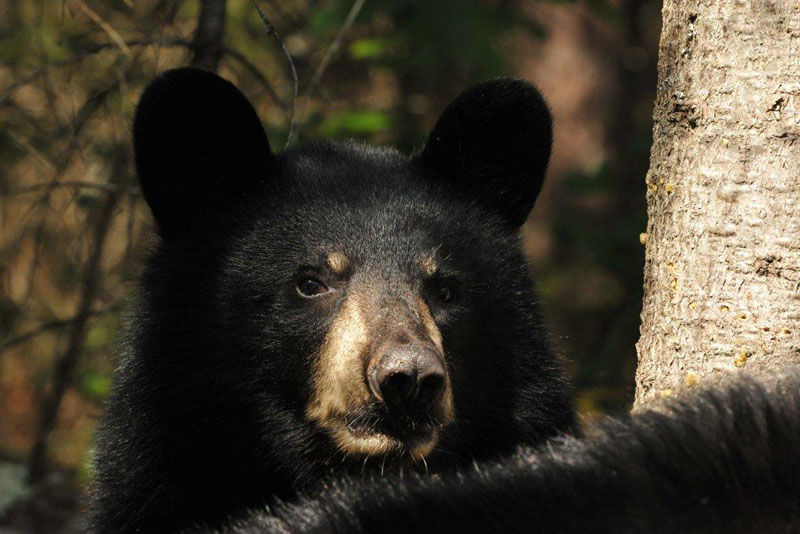
 Juliet's cub - Aug 28, 2012 Juliet’s GPS wasn’t working, so we and the Black Bear Field Course participants began the day locating her and her cubs and replacing the GPS unit. We tried to get heart rates but couldn’t find Juliet’s pulse and the cubs wouldn’t hold still. Juliet didn’t seem very hungry, which made us worry where she was getting food. We do have confidence, though, that the hunters around here will spare her because of her radio-collar, ribbons, and cubs. Aside from hunters’ baits, there is not a lot to eat in the woods right now. Raspberries are about done, and the dogwood berries have mostly dried up. Hazelnuts are scarce.
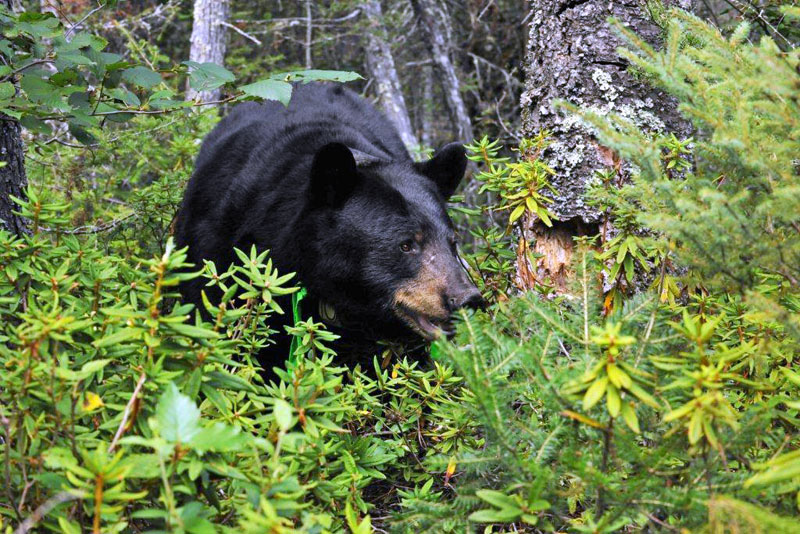 June - Aug 28, 2012June was next. Her GPS showed her to be moving around in semi-swampy habitat that should hold 3-leaved solomon’s seal (Maianthemum trifolium) berries. We are finding those seeds in some scats although this is never an abundant berry. When we checked on June, she was resting. Her heart rate was only 70. Could she be slowing down already? She’s checked den sites lately, and her location today was only 100-200 yards from Jewel’s den of this past winter. We need to check on her again soon to add the bright plastic strips to her collar.
Jewel is doing what 40 percent of females and 69 percent of males did in Lynn’s old study area of the 1970’s. She is taking a trip outside her usual area. She crossed Highway 169 north into Braveheart’s territory, east into Star’s territory, then crossed Highway 169 south into Donna’s territory. Along the way, she paused in an area we know has northern red oak (Quercus rubra). Oaks are scarce around here but do have acorns this year.
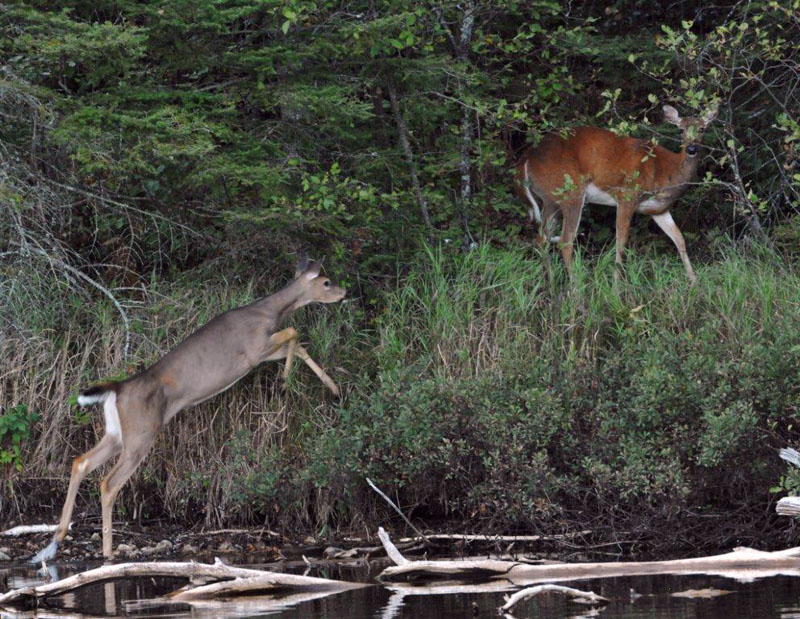 Doe and big fawn on the lake shore - Aug 28, 2012We ended the day on the pontoon boat cruising the shoreline for wildlife on the way to Lily and Hope’s den of 2010. We spotted Aster in the water but she ran into the forest. One of the participants spotted her radio-collar, and our receiver picked up her telemetry signal strong in her direction. Farther along, deer also leaped for shore.
We have been happy to hear from teachers in Canada and Europe who follow Lily’s family in their classrooms. As often as we hear of classrooms across the US that are following these bears, we think that our statement that over 500 classrooms are learning from the bears across America is a gross understatement.
With that in mind, as teachers enter the fall season of their annual cycle of teaching and learning, the Education Outreach Volunteers are encouraging teachers to help advance the long-term survival of bear populations through education. The Education tab at bear.org offers quality materials. The Education Outreach Volunteer Team also encourages teachers who have developed creative lesson plans, games, activities, service learning projects, worksheets, or any teaching aid that supports the above to submit your ideas to
Along that line, architects and designers (including Lily Fan volunteers) are working together to fine-tune the room dimensions in the Hope Education Building.
Another video of Juliet and cubs from July 12 is posted at http://www.youtube.com/watch?v=m0VDjKK6jgM.
Thank you for all you do.
—Lynn Rogers and Sue Mansfield, Biologists, Wildlife Research Institute and North American Bear Center