
 Lily Fans dug up videos of Lucky and Honey a couple days before the interactions described in last night’s update. On March 8 at 4 PM, they had an interaction that helps put their interaction of 7 AM on March 10 in perspective.
On March 8, Lucky made friendly overtures to Honey, grunting sweetly as he confidently extended his nose to her. She did not reciprocate. She laid back her ears and blew and clacked—repeatedly. Then things got loud as Honey rebuffed Lucky’s advance.
How do we explain Lucky’s friendly vocalizations and body language after the tension we’ve seen all winter. Could it be testosterone? Back in the old days, we took blood samples from many males, including 5 samples from late March and early April. Our friends at the Veterans Administration Hospital in St Paul, MN, and at the University of Minnesota School of Medicine analyzed them for testosterone. The 5 samples from late in the denning period showed the second highest testosterone values for the year as you can see at Annual testosterone rhythm in the black bear (Ursus americanus). Could Lucky be perking up and thinking kind thoughts about Honey? Whatever he was thinking, Honey was having none of it. We’ll see if she changes her mind come the mating season in late spring.
The picture above was sent by Donna Andrews, who says
“I snapped this photo of the sunset with my cell phone while I was checking on the bears at 7:10pm. Lucky left the den willingly this afternoon to go play outside. I believe the high temperature for today was 56 degrees. When I checked the bears at 7:00pm,, Lucky was resting in his old day bed that he used as a cub. It is on the protected side of a very large boulder situated near the far side of the 2.5 acre enclosure. The day bed is shaded by several trees and has a nice flat spot that is snow free already.”
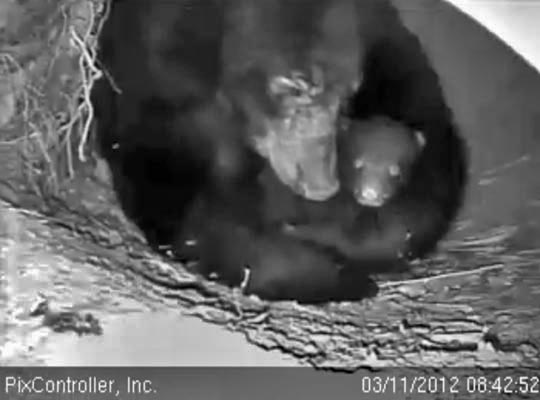 Jewel cuddles cub - March 11, 2012
 Cub is awake while Jewel sleeps - March 11, 2012Jewel’s Den Cam is having problems. Bad timing for a breakdown. Record heat is forecast for all this week. Bears around here typically do not respond to early melts before the last week of March. With the Den Cams, we can actually see what they do with this record situation. The technology team is working on it. It's up at the moment and we’re crossing our fingers.
 No tracks near Lily's den - March 11, 2012
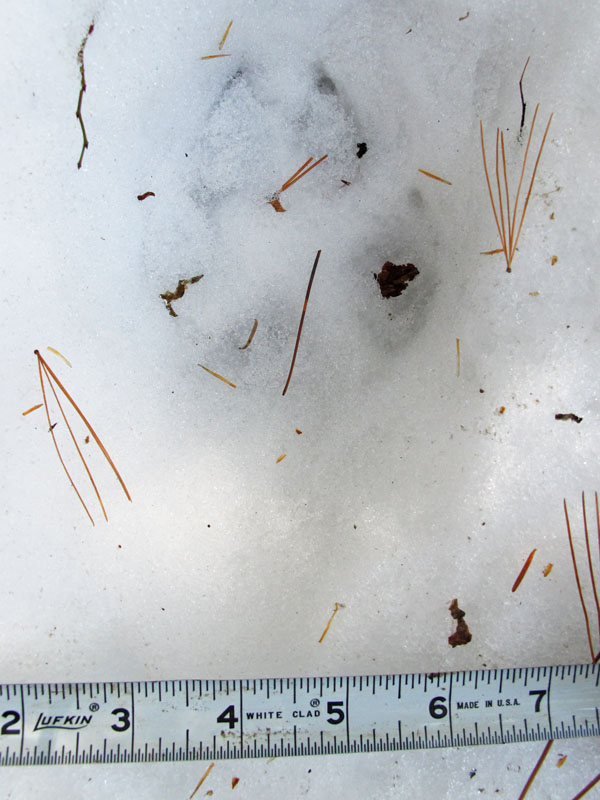 Wolf track - March 11, 2012The big event was last night when Lily was upset about something outside her den for nearly 2 hours. The goal today was to find out what. Sue Mansfield, who is the best tracker I know, went into sleuth mode to find out. She found wolf tracks all over the place, but none within 30 feet of the den. Whatever the wolves were doing, they were not checking out the den—which is in keeping with years of data. Healthy, uninjured bears are usually not closely checked out by wolves, and that includes mothers with noisy nursing cubs that would appear to be vulnerable in above ground nests. Lily’s den is at the edge of a clearcut that has brush and saplings growing up in it. As would be expected, the young vegetation is a deer magnet in winter, and deer tracks were also everywhere, although not by the den. We suspect that the clearcut attracted deer, which attracted wolves. But why did Lily wait until now to show her nervousness?
 Fisher tracks - March 11, 2011There is a confounding factor. The closest set of tracks to the den was a big fisher (Martes pennanti) apparently passing by. The record weight for a big male fisher is only 20 pounds, so it’s possible it came closer to the den without leaving tracks if there was a crust on the snow last night. Would a passing fisher upset Lily for over 2 hours? From the abundance of wolf tracks, they may have been a more persistent presence, although always at a distance.
 Lily in den - March 11, 2012Her possibly being upset about wolves, reminds Lynn of a night he spent with Terri and her cubs some years ago. Terri and her cubs were trying to sleep. A hundred yards or so away, a pack of wolves was dismantling a deer carcass they had found. Lynn had photographed the carcass earlier when Terri found it and dragged it into the bushes. She spent a little time on it, but there wasn’t much meat left, and red meat is not high on the black bear’s list of preferred foods. She shortly continued on eating young, emerging vegetation. That night, when the wolves found it, Terri knew. The wolf rustlings were faint but were enough for Terri’s big ears, and rustling sounds are what black bears key in on. For a couple hours, as Lynn remembers it without digging out the old notes, she was intermittently up on her hind feet standing against the big tree by her bed, slapping the tree, blowing, and clacking her teeth. She would subside for awhile, walk toward the disturbance, return grunting to her cubs, and then turn her attention toward the wolves and continue her agonistic displays. By the time it started to get light, the wolves were gone and Terri was calm. So we do know that distant wolves can disturb a bear.
We were glad to find that nothing was really wrong at the den. A video of Lily's reaction last night to whatever it was is posted at http://www.youtube.com/watch?v=gTgEL2GLLqo.
To continue the discussion about our research methods, the big difference between the old methods and our trust-based methods is that now we can see the bears, summer and winter, and get answers to the many questions that plagued us in the old days.
Tomorrow is the legislative committee hearing of the bill to make the black bear the Minnesota State Mammal. The bill has two numbers. It is Minnesota Senate File 1905 and Minnesota House File 2144. Teacher Dana Coleman’s first grade and second grade students will be there to testify. We’re crossing our fingers. This would be good for black bears and is the result of a lot of work by Dana, her students, and Lily Fans who have contacted their Minnesota Legislators, and supportive legislators. There have been many attempts to select a Minnesota State Mammal. Maybe it takes a group of dedicated students inspired by Lily and family to make it happen.
Thank you for all you do.
—Lynn Rogers and Sue Mansfield, Biologists, Wildlife Research Institute and North American Bear Center