
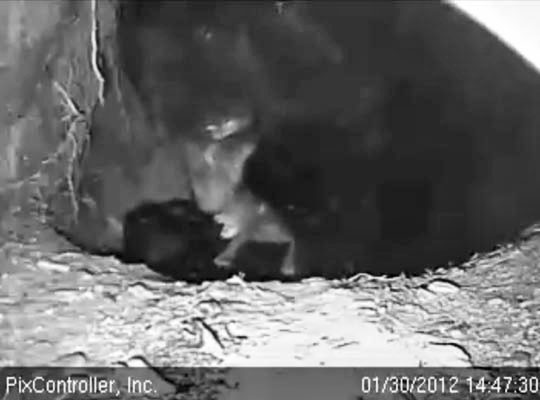
 Jewel nuzzles cub - Jan 30, 2012How long have we heard that during hibernation, bears don’t eat, drink, urinate, or defecate? When it comes to drinking, the belief has been that metabolic water from fat breakdown is enough to sustain them. Maybe that’s true for some bears. But Jewel, June, Lily, and others have shown a strong desire to eat snow. The demands of lactation have not been considered in studies of hibernation physiology that we have read. Lactating bears undoubtedly have higher metabolic demands than other bears. They have the highest body temperatures and they have to make embryonic tissues and then milk. This may be why they breathe more frequently than other bears we’ve watched, which, in turn, would result in more water loss.
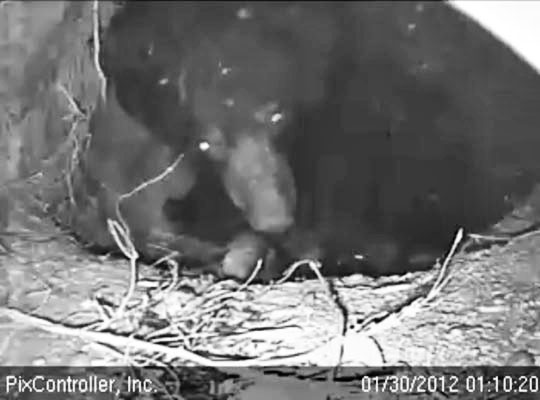 Jewel's eyes reflect as she nuzzles cub - Jan 30, 2012For the last week, Jewel has frequently looked toward the den entrance and started out only to settle back down when the cubs protested. Today, with the temperature at 21 F and the cubs fussing about her taking her warmth away from them, she was not to be deterred. She spent a full half hour crunching snow. The Den-Watchers are recording all this in detail for an eventual peer-reviewed publication and we have archived footage for review if needed.
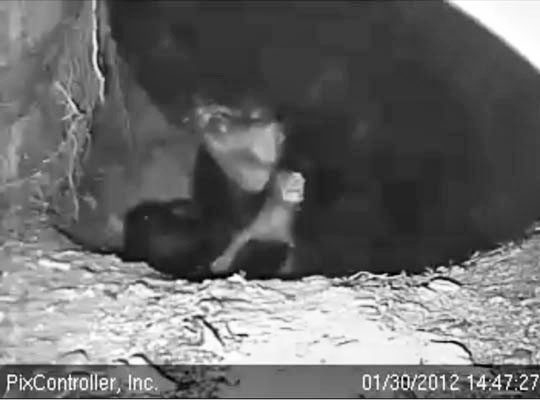 Jewel nuzzles screaming cub - Jan 30, 2012The Ojibway had a legend that when it snows during the Bear Moon, the first moon of the year, mother bears are giving birth and calling for snow for washing their cubs. Did the Ojibway notice that lactating mothers have a greater need for snow? Did they notice the extra signs of snow consumption at the entrances of mothers with cubs? Did the Ojibway know back then what Lily and Jewel are showing us today about the need to obtain water beyond the metabolic water of fat breakdown?
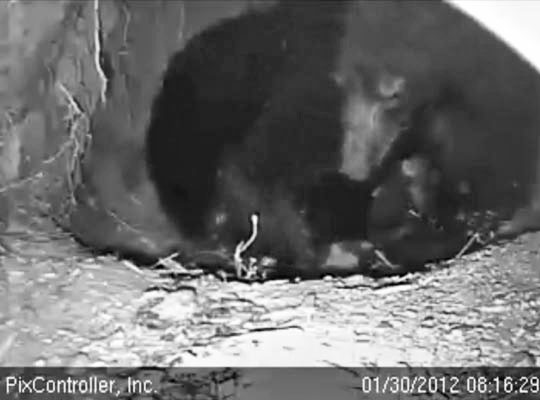 Jewel and cubs - Jan 30, 2012In hibernation experiments in medical research labs, non-lactating bears have gone through hibernation without drinking. But we are seeing that even Lily is eating a little snow. We now suspect that the bears in the experiments must have become pretty thirsty.
Any way we look at it these animals are “metabolic marvels” to quote Dr. Ralph Nelson who recently died and was one of the pioneers of hibernation physiology who we worked with some years back.
 tracks outside of Jewel's den - Jan 30, 2012A major benefit of the Den Cams is that they make learning intriguing and enjoyable. From preschoolers to researchers and people around the world, we are all learning together. We are all sharing the joys of discovery. Learning in this way is not a chore that brings no enjoyment or understanding, as Bruce Alberts, Editor-in-Chief of Science Magazine discussed in his January 20 editorial. He advocates less rote memorization and more involvement with life processes to keep science from being dull. That is one reason so many teachers are using the Den Cams in their classrooms—they can see the results in the students’ faces and hear the enthusiasm in their questions.
A video of Jewel and cubs from Jan 29 is posted at http://www.youtube.com/watch?v=8GTR8v4BrIs . This video shows Jewel being very alert and defensive towards something outside of the den. Today’s PTZ footage revealed large tracks passing the den. Check the bearstudy YouTube channel at http://www.youtube.com/user/bearstudy#g/u for additional videos posted in recent days.
Thank you for all you do.
—Lynn Rogers and Sue Mansfield, Biologists, Wildlife Research Institute and North American Bear Center