
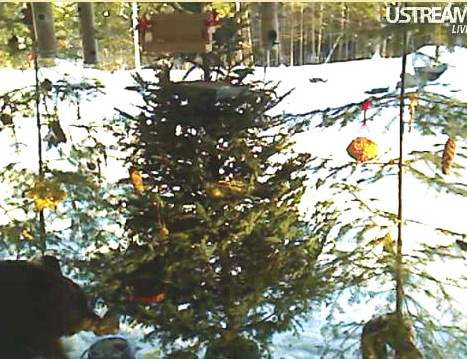
 We wondered if it would happen. The staff discussed whether Honey would come out and whether the extra electric fence should be activated or not. She did come out. The extra fence was not activated and the regular electric fence is off because it’s in snow. Honey loved the trees and treats. She kept eating until she was done. Your treats were so good, that Honey ignored anything John or Jason offered to divert her. Bears will be bears. For now, the temptations are removed. The word is to get a battery, activate the extra fence, put the trees back, and see what happens.
Maybe we should skip the trees and just hang treats out of Honey’s reach for the birds. But we like to feed Rocky, too. The staff will get it right. That’s why we call them the Miracle Team.
But for today, Honey had a treat and it’s back to the drawing board while the birds eat from feeders for awhile.
Yesterday, Honey was sleeping soundly with temperatures near 20 below. She was breathing 3.3 times a minute with her nose deep in bedding. Breathing into the fluffy bedding made of leaves helps her conserve water and warmth by re-breathing some of the exhabled air.
Today, the temperature got up to 3 below. Maybe she got a whiff of suet, peanut butter, and sunflower seeds only 15-20 yards from her den. Some bears would not care about that when they are hibernating. Honey does, though. Her brown fur makes us thinks she has western genes adapted for an area that sometimes has winter food available. Bears in such areas are adapted for coming out to forage if food is available. It’s the same in the eastern deciduous forest where there are sometimes good beechnut, hickory nut, or acorns crops to be found under the snow all winter. After a good beech nut crop, Sue Mansfield tracked several bears in the snow in southern New Hampshire all winter long. The bears sniffed out the nuts and dug down through the snow. But here in northern Minnesota, bears go into dens and stay there no matter what the temperature or food availability. People who feed bears in northern Minnesota see bears abandon food and go into dens in September or October. People who feed bears in southeastern states see bears for most or all of the winter. Honey is supposed to be on a diet, but she apparently has no willpower.
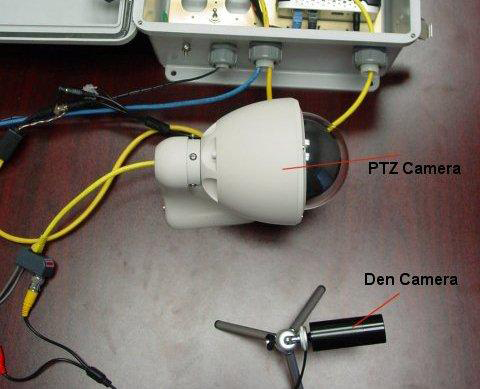 Jason is trying to get the webcam in Ted and Lucky’s den to work. He is communicating in techno-lingo with Voltz Technology in Ely and WildEarth.TV in South Africa. Words we hear include network, ports, video server, modem, IP address, access, stream, link, Realplayer, Quicktime, TCP, and UDP. They’ll work it out eventually. Picture is Lily & Hope Den Cam hardware, waiting to be installed.
The Lily and Hope den cam team are shipping equipment, making calculations, and getting ready to travel here. Things are coming together.
We’re trying to get used to the new bear.org website and can see that it has several advantages.
Meanwhile, you are donating to the Ely Area Food Shelf at PO Box 786, Ely, MN 55731 and showing the town folk that the radio-collared bears bring good things to Ely. All donors will be listed in the newspapers with a special section for Lily fans.
To further help protect Lily and the other radio-collared bears, you are writing letters to Governor-elect Mark Dayton to let him know the world cares. He is at Transition Office, 800 Minnehaha Avenue East, Suite 201, St Paul, MN 55106.
Thank you for all you are doing.
The oranges you sent to the Bear Center are going fast. Thank you again.
—Lynn Rogers and Sue Mansfield, Biologists, Wildlife Research Institute and North American Bear Center