
Unique and Specialized
November 9, 2010 – 7:49 PM CST
 Word from the hunting camp near Lily and Hope’s den is that the hunters are staying well away from the den and went through the first weekend of deer season without firing a shot.
The weather is clear and calm with temperatures near 60—about as beautiful as it can get in early November, but the bears are not roaming here in the Northwoods. Some will still be raking bedding into their dens, while they all rest more and more.
Lynn is an obsessive editor and has rewritten the introduction to his book several times. Sue says one of these days he has to move on to page 2. Here is the link to the much revised and expanded version http://www.bear.org/website/lily-a-hope/research-updates/671-daring-to-trust.html. Lynn thinks this could be it.
The introduction reminded us how unique and specialized this study is. It is an intensive study of a few bears to obtain insights into their behavior and ecology that could not be obtained any other way. There is no substitute for watching bears that trust and ignore you. We are not aware of anyone else doing this type of research. We began in the mid-1980’s. Terry DeBruyn worked with us briefly and then did a similar study that we helped fund in Michigan in the late 1980’s. It was his Ph.D. project, and the book he wrote about it “Walking With Bears” is one of the best bear books out there.
Nobody has picked up on the method and done anything like it since. And there are good reasons. Most graduate students can’t put enough time into their project to gain the trust of wild bears to observe natural behavior. Most government jobs have rules about number or hours worked. Many colleges won’t allow interns to work closely with bears. Some parts of the US have too many poisonous snakes to follow bears through forest and swamp at night. Some areas have terrain that makes keeping up with bears too difficult. Many studies require too large a sample size to gain the trust of individual bears for radio-collaring.
Research methods are dictated by the research objectives. Many studies require tranquilizing to implant monitors or do physiological biopsies, blood sampling, tooth extraction for aging, etc. Some require ear-tagging and/or tattooing for permanent identification.
We don’t do any of that. Our objective is to observe natural behavior. We build trust and don’t do anything to make bears worry that we might be about to hurt them. That’s why they ignore us and go about their lives. We offer them limited treats in exchange for letting us replace radio-collars, take heart rates, or examine them for injuries. Building trust is the only way to learn the true nature of bears and see how they live undisturbed.
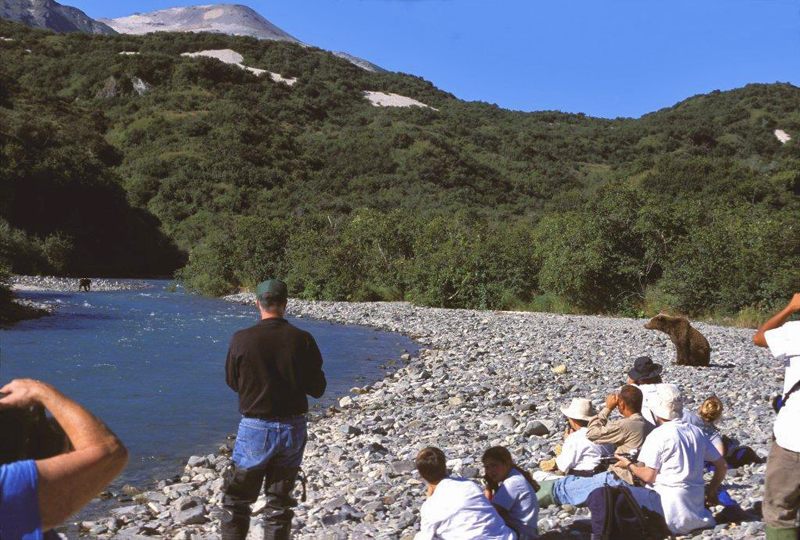
There are a few places in the world where other species of bears might trust people enough to walk with them. In Alaska, some coastal brown bears are so used to people that they ignore them (picture). Lynn accompanied a mother with cubs at distances as close as 6 feet while video-taping them. In Kamchatka, Charlie Russell raised orphaned brown bear cubs and walked with them as adolescents and young adults as they explored the countryside and established wild territories. On Wrangel Island north of Russian, Nikita Ovsyanikov walks among polar bears carrying only a stick. In Alaska, Dr. Steve Stringham, Kent Fredrickson, and Tim Treadwell regularly are/were extremely close to brown bears without a problem. Tim Treadwell was not killed as a result of walking with bears as a benign observer. He was killed running a bear out of his camp. Confronting and challenging bears that powerful apparently had its limits. For the most part, the bears accepted Tim and basically ignored him, as Lynn’s pictures of Tim with bears show. One memory Lynn has is of Tim sitting on the ocean beach as a mother and cub came by. They completely ignored Tim as mother and cub stopped to play with each other maybe 8 feet from Tim. Other females feel so comfortable with people that they can avoid males—that are timid around people—by bringing their cubs near people to nurse them.
One of the misconceptions about bears in general is that as bears lose their fear of people, they become more likely to attack. What bears are actually showing us is that they become more likely to ignore us, which is what makes our kind of research possible.
We just noticed that the NABC thermometer is nearing the $400,000 mark, making a major difference in our debt and getting us closer to achieving some of the educational goals we are all about. Thank you so much for all you do.
—Lynn Rogers and Sue Mansfield, Biologists, Wildlife Research Institute and North American Bear Center