
Daring to Trust
November 7, 2010 – 8:32 PM CST (revised 11-09-10)
We’re still remembering yesterday’s birthday festivities as we eat the delicious leftovers. Lynn went for a birthday walk and drive with Donna today. Then they went home to nibble at the birthday cake you sent. Even while saying “Neither one of us needs this,” they helplessly ate away.
No bear news today but lots of talk about how best to set up a den cam in Lily and Hope’s den far from electricity and telephone. Words frequently heard included 3G, WiFi, tower, elevation, terrain, distance, etc.
The research bears are settled in dens. We have located most dens and have approximate locations from telemetry readings on the others. The deer hunt is in progress and we will concentrate on office work until the hunt is over. Then we’ll recheck den locations to see if any bears moved during the hunt.
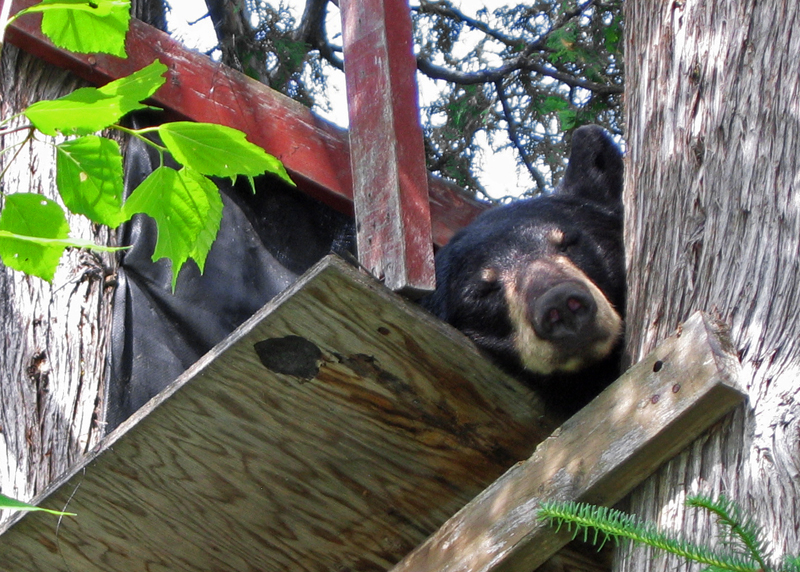
If you’re a hunter, and ever wondered who or what had used your hunting stand when you weren’t around, this picture is for you! On August 3, 2007, we found June sleeping in a very rickety hunting stand built between 2 cedar trees. Her 3 cubs (Lily, Cal, and Bud) were safely resting in one of the trees.
Lynn (71) wants to write a book before he loses his marbles. He wrote the forward today. It obviously needs editing, but it’s a start. Here it is. We’ll see where it goes. Expect more in the days to come.
Book title: Daring to Trust: my life studying black bears. By Lynn Rogers
Introduction
I used to fear bears as much as anyone. How could I feel any different growing up with warnings, snarling taxidermy, and hunting magazines? To me, bears spelled danger, especially mothers with cubs. The few bears I’d seen didn’t seem that bad, but “You never know. They’re wild and unpredictable.”
Black bears confirmed my fears when I began capturing them for research back in 1967. Bears in steel traps, foot snares, or live traps lunged and slapped at me making startling noises. Their explosive demonstrations of power inspired caution. I seldom gave bears chances to show what they’re really like in those early years.
But sometimes things went awry. “Close calls” added up over the years without injury. No bear came after me and hurt me. Might bears use restraint?
I became more objective. I learned their language. I realized that their ferocious-looking behaviors were actually harmless, ritualized expressions of their own apprehensions.
As the veil of fear lifted from my eyes, I saw basically timid animals whose lives are ruled by fear and food. I began interpreting their behaviors in terms of their fear rather than my fear. In the process, I learned good bear manners—how to put them at ease and gain their trust. As my understanding grew, I opened my heart to the wonders of these intelligent animals that have feelings, personalities, social relationships, and wild agendas. And I found that even the largest of them, powerful males weighing upwards of 800 pounds, are often among the most calm and gentle.
I found myself walking with bears 24 hours at a time, recording data into a field computer as mothers calmly foraged, napped, or nursed their cubs. Far from the unpredictable beasts I once imagined, I walked and rested with them day and night without worry.
Gone were the days of traps and tranquilizers. No longer was I corrupting data with capture injuries and tranquilizer deaths. Instead, trust and occasional treats were all I needed to fit bears with radio-collars, take heart rates, and watch them live. My new kinder and gentler research methods were revealing more about their lives than I ever dreamed possible.
Many had warned me that bears attack when they lose their fear of people. In reality, they ignored me. I was not a competitor. But neither was I a significant food-giver. I was not an enemy. But neither was I an object of affection. I was inconsequential. The less they feared me, the more they showed me how they live.
Day after day, they refuted misconceptions, many of which are still believed by wildlife officials and the public. Some things that make human sense just don’t make bear sense, as they continue to teach me today.
This book recounts the events that shaped my understanding of black bears and led to the mutual trust that lets them reveal their true nature.
Again, thank you for all you do.
—Lynn Rogers and Sue Mansfield, Biologists, Wildlife Research Institute and North American Bear Center