
How will it end?
October 21, 2010 – 8:38 PM CDT
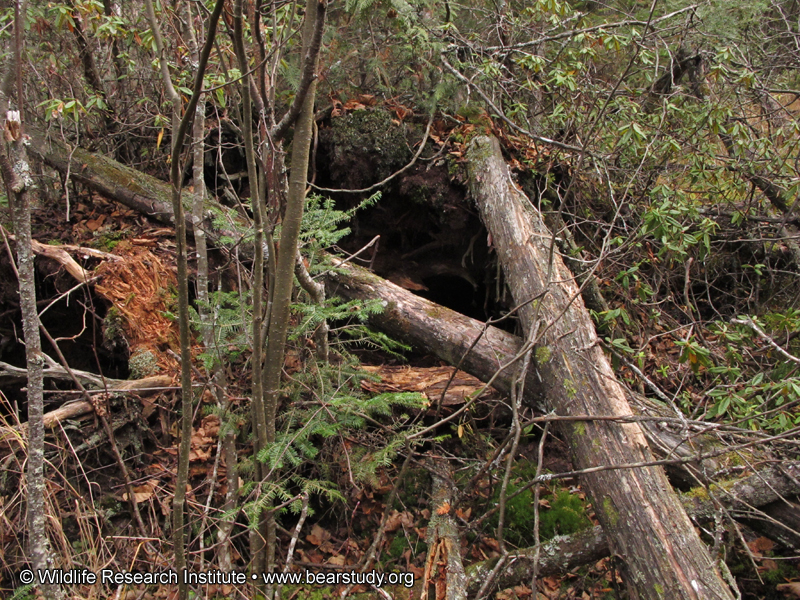 Braveheart sat tight all day. Lily and Hope did the same until about 4 PM when they moved the remaining 90 yards to their nice bed near the wet ‘possible den’. We’ll check in a day to two to see if they’re raking bedding into it or realizing the folly of their ways. Maybe they have no intention of using it. This picture of the den is taken from a different angle than the one posted on Oct 19.
What should we do? Just watch and report. We can’t tell them what to do.
Some history for newcomers, including our perspective on what happened.
January 22. Hope is born. Litters of one often have problems. We think that for some mothers one cub does not nurse enough to prevent development of ova. Mothers with one cub can come into estrus and be confused about their purpose.
May 21. Lily left Hope sleeping up in a tree in a location with fresh tracks of a large bear, probably a male. Lily came back a couple days later after it had rained hard and washed away Hope’s scent.
May 26. Hope was found up a tree 2 miles from where Lily had left her. We knew that if we let her did nothing we would not learn anything we didn’t already know. Giving her an opportunity to unite with Lily would answer a lot of questions. When they saw each other, Hope nursed a long time. They spent the next couple days nursing and playing. But Hope was still just one cub. We were learning. We all were learning.
May 31. Lily saw her mother June approaching. Hope climbed a tree. Lily left. Could Hope find enough food to replace her mother’s milk? We weren’t sure. If she died, it would be no surprise and that would be all we would learn. If we supplemented her wild diet, we could learn much more. If Lily and Hope did not eventually re-unite, we would see if supplementing an orphan with food in the wild would lead to a better outcome than placing her in captivity for a year and then releasing her into the wild. Lily was in estrous and would likely breed. If she found Hope, would she want her? Would it lead to a mixed-age litter? If Lily and Hope were to re-unite, we could learn what happens in the mixed-age litters that are reported. All mixed-age litters we have seen reported had one older cub and several younger cubs all following mom.
July 11. Lily and Hope re-united on their own. Lily resumed lactation. They appeared to be like any other mother and cub. We all were learning.
September 23. Lily and Hope dug a den high and dry, which we found on September 24. Then they began gallivanting across the landscape. Did they not like the den they dug?
October 19. We discover that they have the beginning of a den in a wet area.
October 21. They return to the bed near that possible den. We don’t want them to use it but can do nothing about it. They have to be free to make their own mistakes. How often have we realized that what makes human sense does not make bear sense? Our job as researchers is mainly as reporters, although sometimes new experimental approaches must be used to learn new things. If they den in the wet area, we will simply watch and report.
What could happen? It’s possible that everything will be fine. Lily and Hope could den there. Lily could produce a litter. The den could stay dry enough during a cold winter without a thaw, and by the time the snow melts and floods the den in spring the cubs will be developed enough for Lily to move them to dry ground as RC did one year in a similar situation. That would lead to a family that includes Lily, Hope, and the new litter. We are assuming the litter will survive with Hope around because a number of mixed-age litters have been reported. With the stimulation from 2 or 3 new cubs nursing, Lily won’t come into estrus and won’t likely separate from Hope. Hope could get an additional year with Lily to make up for the six weeks she had to spend on her own this year. If the cubs died of exposure in what could become a wet den, it would just be Lily and Hope that emerge. Lily would come into estrus and separate from Hope during the mating season right on schedule for them. Life would go on for Lily and Hope right on schedule, just as if they didn’t have all the ups and downs of this year.
All we can do is wait and see. We can all see together what happens in the den. If they den in the wet den, providing electricity and signal transmission way out there will be difficult. We’ll make it happen one way or another. After they leave the den, we will report progress as we are now. Inquiring minds want to know.
At the Bear Center, the staff is following the lead of the wild bears for Lucky, Ted, and Honey. When they learned that Dot had used moss for bedding, they collected a lot of moss, put it on the ground, and watched how the bears responded. They raked it into their dens.
Also at the Bear Center, you sent enough good meat and cookies that there was still some there when Lynn stopped by hungry. The thin-sliced turkey was so good that he had to keep getting the tray out of the refrigerator for one more bite. Although he is supposed to be on a diet (236 pounds and counting down), he had to keep getting the smiley cookies out for yet another. He took four home for Donna, and left a full package there for the staff. He says, “Thank you!”
On the School voting contest, the second place school is gaining on us, but not quite at a rate to overtake us in the 22 days remaining. It’s a situation to watch. We want to win to help Ely’s Schools and to show the value of the radio-collared bears and their fans at this crucial time of trying to make it illegal to shoot them. Today, we got another call from a magazine writer who is writing about the Lily phenomenon and all the good you are bringing to the area. To vote, go to http://www.care2.com/schoolcontest/2704/054/.
—Lynn Rogers and Sue Mansfield, Biologists, Wildlife Research Institute and North American Bear Center