
Braveheart visits her den, Jo gives us a scare
October 2, 2010 – 9:43 PM CDT
As it was getting dark between 6:55 and 7:04 PM, Braveheart arrived at her den—the den she showed us back on June 30th. She has visited it several times in the last few weeks and has hovered near it since last night. Will she stay this time?
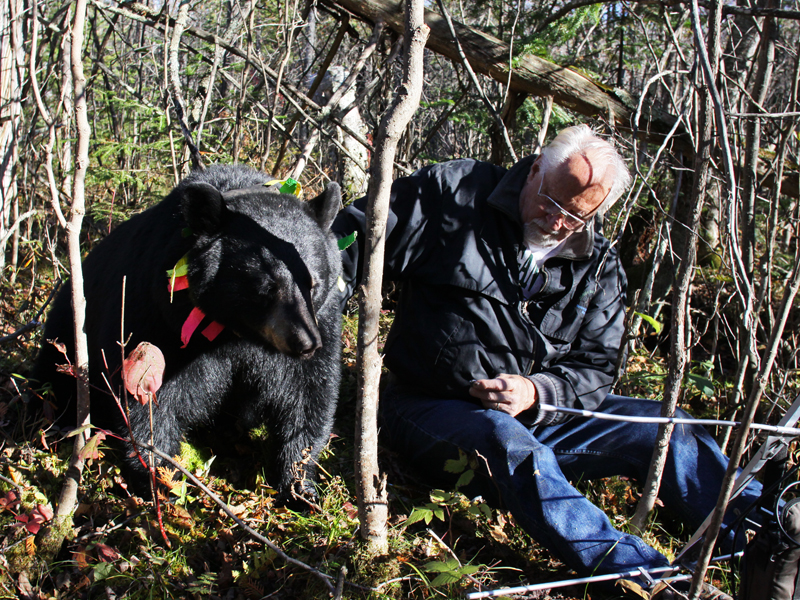 Jo gave us a scare when her GPS signal quit and we couldn’t hear her telemetry signal. We feared the worst. Could she really have traveled out of telemetry range after we found her heart rate slowed to only 49 a week ago? We thought maybe she was deep in a rock den that shielded her signal. We split up and scoured her territory and beyond. Finally, we got her signal 5 miles from her last location—a long way to travel, we thought. We phoned to regroup, walked into a beautiful cedar swamp, and found her bedded in moss and grass at the base of a cedar (picture below). She stood up as we approached. Her heart rate was 62 (picture left). She is now 1.9 miles west of the rock den she almost got stuck in a week ago and 4.5 miles west of the log den she was in a couple days ago. We checked the 4 by 8-inch area on her back where she lost hair squirming out of the rock den. The guard hairs are gone, but her inch of dense underfur is still present, so the spot shouldn’t get too cold this winter. But that couldn’t have felt good getting all those guard hairs pulled out in her attempts to get out of the den!
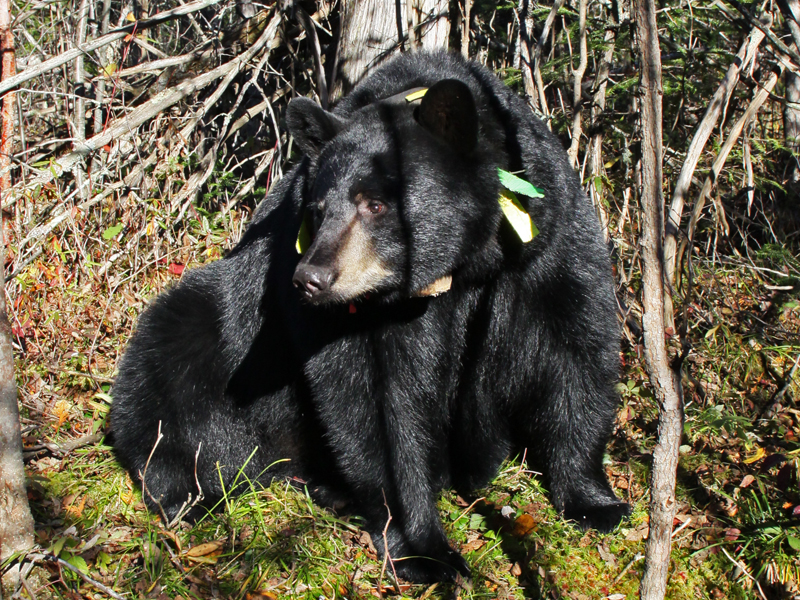 Juliet and the cubs are still the same story of resting during the day, moving in the evening, and resting overnight.
Lily and Hope have been in the same lowland spot since 7:45 PM last evening, and it is now nearly 26 hours later. Could it be a den? Probably not, considering that it is a lowland, but we’ll have to see. We dearly hope she goes back to the nice dug den she made 1.9 miles away.
Following up on last night’s update
We believe education can make more of a difference for bears than anything else we all can do. When people know what black bears are really like, when they replace the vicious hype of the media with scientific facts, attitudes will change. As word of Lily and Hope and the other research bears spreads across the nation and around the world through the developing Education Outreach Program, people will learn that black bears are not the ferocious animals they once thought. They may look at all bears with a more open mind and become more willing to coexist with them.
As people learn that bears, even grizzly bears, are intelligent, basically timid animals, people may no longer let them languish in cages too small to turn around in—as is the case for thousands of bears in Asian bile farms. People will no longer allow bears to be kept in concrete zoos and other substandard conditions that drive intelligent bears mad with psychoses of boredom, reducing bears’ lives to pacing and other mindless repetitive movements.
As people realize that bears are sentient beings that feel pain and emotion and have a need to stimulate their minds to remain mentally sound, they will no longer think of them as varmints that don’t feel pain and can be subjected to inhumane treatment.
Hunters will also benefit. In Minnesota, education led landowners to coexist with more bears. Less shooting by landowners and a limited hunt allowed the bear population to quadruple and their range to spread, which, in turn, provided more hunting opportunities. We believe education benefits bears, as well as those who enjoy seeing bears, and those who want to hunt them. A major purpose of hunting is to control bear numbers to a level people will tolerate.
We have become a working group—working to spread the truth about bears and promote reasonable coexistence. People will never tolerate unlimited coexistence, of course, and hunting is a more humane way to limit bears to the numbers people will tolerate than the methods used in the old inhumane days of gut-shooting, trapping, and poisoning. Around the world, perceived threats to people and their livestock and crops are major limiting factors for bears. The less fear there is, the less killing there is. Education is the key to survival of some endangered bear species and the numerous black bears that live among us in North America.
As we finished writing this, we noticed that in the last 77 minutes Braveheart moved nine tenths of a mile away from the den and is still moving. Will she ever settle down?
On another topic, Wow! You have put Ely Schools in the lead in the Care2 school contest by 1,573 votes. Every day, you widen the gap a little more. Newspapers are noting what you are doing for the area and that it is a direct result of the radio-collared bears. We are hoping this resonates with law-makers as one more reason to give protection to these radio-collared bears.
Thank you for all you do.
—Lynn Rogers and Sue Mansfield, Biologists, Wildlife Research Institute and North American Bear Center