
Pre-denning behaviors
September 20, 2010 – 9:12 PM CDT
 We’re wondering if bears that stay in one place awhile and then move on might be trying to dig dens and being thwarted by big rocks like happened to Lily at 3 spots where she tried to dig dens last year at this time. Finally, she gave up and went back to an existing den she had checked out. That ended up being the den we all became so familiar with. Some of the locations where bears are spending time this fall are accessible enough that we can home in on the GPS coordinates to check for possible digging.
This evening, after spending two days in two spots near each other, Lily took Hope on a mile walk between 6:29 and 7:39 PM as it was getting dark. Then they stopped. We don’t know what they are up to. Perhaps tomorrow we will learn more.
Braveheart has us excited. At 7:06 PM, she arrived back at the dug den she showed Sue on June 30th. Is Braveheart just checking it out, or is this the moment? She has been roaming about the area for a couple days and appears to have bedded in several different spots—but keeps coming back to the dug den.
Jo more or less settled into a small area the past 3 days. We wonder if she was digging a den. Then, from 4:19 PM to 6:12 PM, she walked four tenths of a mile in a circle back to where she was. Then her signal ended. Did she enter an underground den? We’ll check her radio-signal tomorrow to see if she is still in that area. If she doesn’t end up denning there we’ll want to search that area to see what she was up to.
Juliet is still active but had a heart rate of only 62/minute at 6:15 PM. Cubs heart rates are always higher, and two of them had heart rates of 120 (Sharon) and 124 (Boy Named Sue), but Shirley, the heaviest, was down to 102 and 106 in two readings.
Ursula continues to spend all day in one spot and then move three quarters of a mile to a feeding station at about dark each evening. Is she just resting all day, or does she have a den there? Her daytime resting place is at the edge of a cedar swamp, and we can’t tell from the GPS locations on the aerial photo if she is in the swamp (den less likely) or the upland (den more likely). Her pattern reminds us of Blackheart back in the fall of 1999 when she spent all day in a den and then moved three quarters of a mile to a feeding station each evening for an hour or two.
Some good letters to editors at the Ely Echo, Timberjay, and Duluth News Tribune have been surfacing, all surprises. The good letter from Doug Brown of Timber Wolf Lodge, not far from Ely, has been posted on Facebook (http://www.facebook.com/lily.the.black.bear?v=app_2373072738#!/topic.php?uid=263755115498&topic=18160). Unfortunately, there doesn’t seem to be an online version of the letter on the Ely Echo's website.
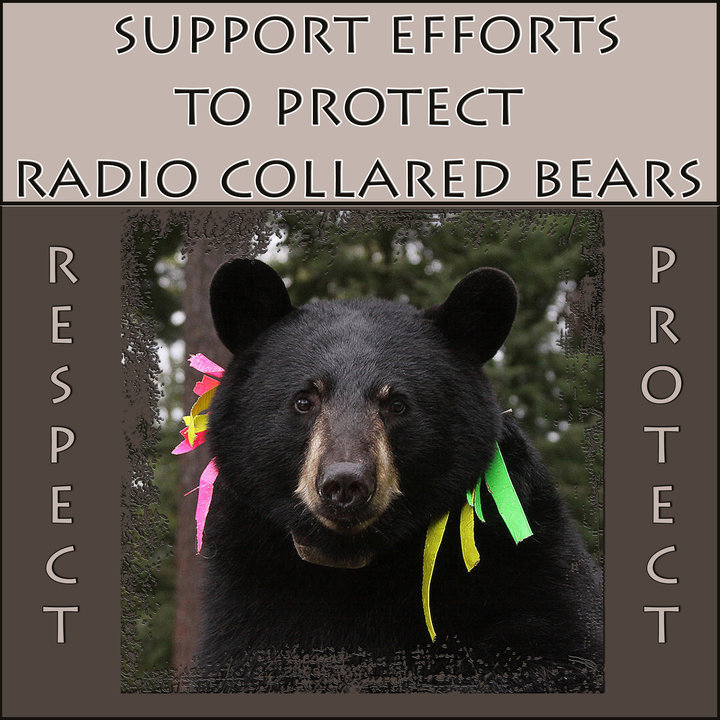
You showed us some great posters in support of protecting the radio-collared bears. We liked them all, but this one captured the eyes and gentleness of Jo in an especially compelling way. We want to print the posters out and put them up in the Bear Center.
Today, we finally sent our 8-page request in to Commissioner Holsten asking for a Commissioner’s Order to protect the radio-collared bears wearing ribbons in central St Louis County (the study area).
Also today, voting opened in a new contest to vote $20,000 to the Ely School District. Last we checked at 6 PM, Ely had 298 of your votes and was leading the second place school which had only 33. However, that school was one of the top vote-getters in the previous school contest, so they will likely put on a big push. Each person gets only one vote so spread the word! The link to vote for the Ely School District is http://www.care2.com/schoolcontest/2704/054/?refer=9880.01.1284979606.252382.
Your voting for things for the community like you have done and are doing seems to be making a difference in the battle for protection of the radio-collared bears. Letters to editors are noting your contributions to the community and that this is a result of what the radio-collared bears are showing us.
Thank you for all you do.
—Lynn Rogers and Sue Mansfield, Biologists, Wildlife Research Institute and North American Bear Center