
Fall marking behavior
September 13, 2010 – 8:30 PM CDT
 As far as we know, all of the research bears are fine. Hunting pressure has fallen off and will continue to decline as the season progresses and bears seek dens. The grouse hunt begins Saturday and many hunters will switch to grouse hunting.
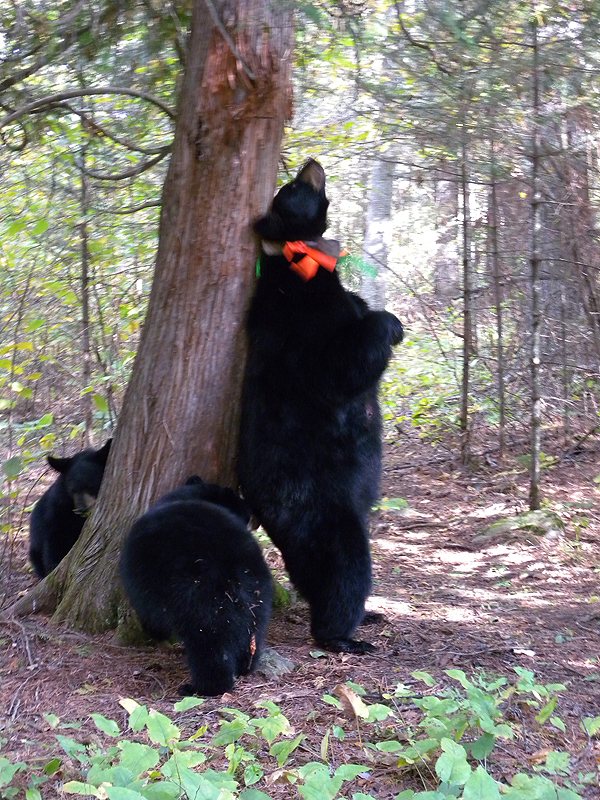
The BBC film crew spent time over the last couple days with Juliet and her cubs to film bear behaviors. Juliet obliged. Even though she is not in an area we consider her territory, she is spending considerable time and energy marking—both by rubbing trees and stomp-walking bear trails. Females have a spurt of marking behavior in the fall whereas males do most of their marking during the spring mating season. In this picture, Juliet is back-rubbing a cedar tree that has been heavily rubbed and bitten by other bears. You can see the bites from the large males about a foot above Juliet’s head. Her cubs seem to be checking out the scents on the tree. The picture is a bit blurry but the behavior is unique and difficult to capture.
 It’s not unusual for radio-collars to spin around when a bear rubs a tree. In the second picture you can see Juliet’s GPS unit neatly tucked in under her chin. Fortunately, her further activity spun the collar back around and our location data collection continued.
The GPS units have revolutionized the way we do research. We could see on our computer today that most of the radio-collared bears are bedded all day. However, they're all active at the moment. We’re watching now as 5-year-old Ursula moves off to den. She should have cubs this winter and we’re eager to see where she settles in. She was a yearling the last time we were able to locate her den.
We feel a mixture of relief and melancholy each year when the bears are settled into dens. After the intensity of the field season it takes a while to shift gears from data collection to data crunching and writing. Last year, the immense interest in the Lily den cam took us by surprise. This year, at least we have a clue what lies ahead as we plan for new den cams. Stay tuned!
Thank you for your continued interest and support of our research and educational efforts.
—Lynn Rogers and Sue Mansfield, Biologists, Wildlife Research Institute and North American Bear Center